
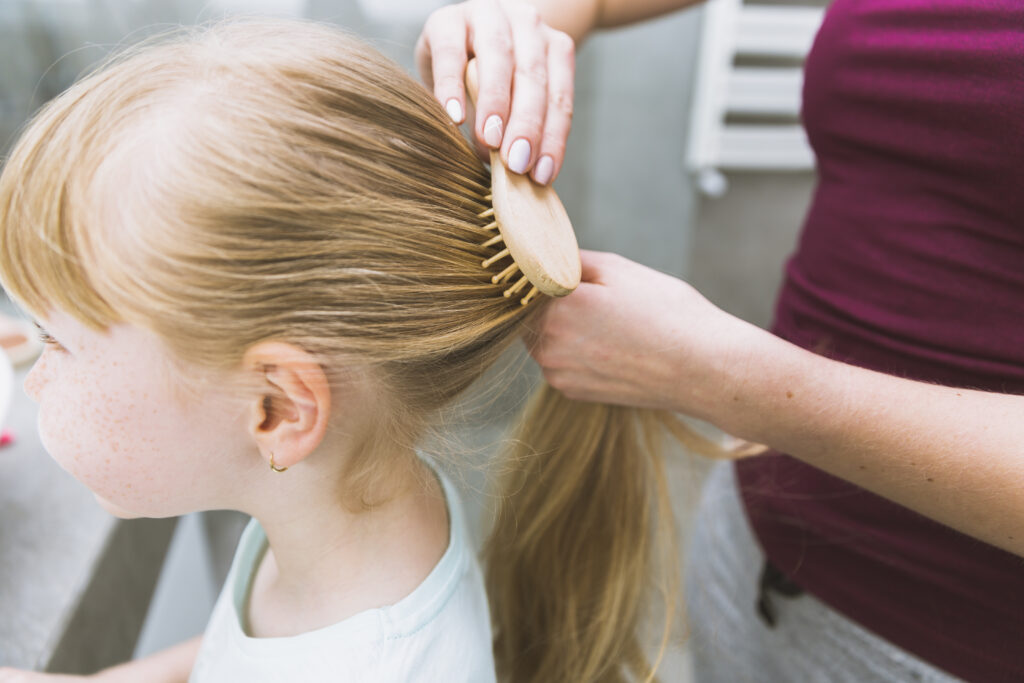
The French braid looks complicated, but it comes down to one repeating pattern: cross three strands, add a little hair to the outside strand each time, and repeat. Once your hands learn the rhythm, it becomes almost automatic — but getting there takes a few honest tries with hair flying everywhere.
This guide breaks the How to French braid down into clear, repeatable steps, with tips for keeping it tight and tidy, especially if you’re braiding your own hair for the first time.
What You’ll Need
- A hairbrush or comb to remove tangles before starting
- Hair ties or elastics to secure the end
- Bobby pins (optional, for securing loose pieces)
- A mirror — or two angled mirrors if braiding your own hair from behind
- Slightly damp or day-old hair, which holds a braid better than freshly washed, slippery hair
How to French Braid: Step by Step
Step 1: Start Your Section
Take a section of hair at the crown of the head, in the direction you want the braid to go (typically starting near the hairline and moving toward the back of the head). If you’re learning, it can help to practice on someone else first, or practice a small braid along your part where you can watch your hands in a mirror.
Step 2: Divide Into Three Strands
Split your starting section into three roughly equal strands — left, middle, and right. Keeping these strands distinct and untangled from the start makes everything that follows much easier.
Step 3: Do a Basic Cross
Cross the right strand over the middle strand, so the right strand becomes the new middle. Then cross the left strand over the new middle strand, so the left strand becomes the new middle. This basic over-under crossing pattern is the foundation of every braid — French braiding simply adds new hair into the mix as you go.
Step 4: Add Hair to the Outside Strand
This is the step that makes it a French braid rather than a regular three-strand braid. Before crossing a strand over to the middle, pick up a small new section of hair from along your part and add it to that strand. Add the new hair at the same height as the braid itself — grabbing hair from too high or too low creates uneven lumps and diagonal lines in the finished braid.
Step 5: Cross and Repeat
Cross the outside strand (now with the new hair added) over the middle strand. Then switch to the other side: add a new section of hair to that outside strand, and cross it over the middle. Continue alternating sides — add hair, cross over the middle, switch sides, repeat — working your way down the head.
Step 6: Finish With a Regular Braid
Once you run out of hair to add (you’ve reached the nape of the neck or wherever you want the braid to end), stop adding new sections and simply continue the basic three-strand crossing pattern down to the ends. Secure with a hair tie.
Tips for a Tighter, Neater French Braid
- Use slightly damp hair: Freshly washed, very smooth hair tends to slip and is harder to control. Day-old hair or hair with a little texture product holds a braid more securely
- Keep your hands close to the head: The closer your hands stay to the scalp as you braid, the tighter and more secure the final braid will be
- Add hair at consistent height: Always grab new sections at the same height as the braid itself — this is the most common source of lumpy, uneven braids
- Keep strands smooth: Take a moment to smooth out each strand before crossing it — tangled strands make for a messy-looking braid
- Practice on someone else first: It’s much easier to learn the motion on hair you can see clearly in front of you before attempting it on your own head
French Braid vs. Dutch Braid
A French braid and a Dutch braid use the exact same technique — adding hair to the outside strands as you go — with one key difference in the crossing direction:
- French braid: Strands cross over the middle strand, creating a braid that sits on top of the hair
- Dutch braid: Strands cross under the middle strand, creating a braid that appears to sit on top of (or pop out from) the hair — sometimes called an “inside-out” braid
Once you’re comfortable with the French braid pattern, the Dutch braid is simply the same motion in reverse — a useful next style to practice.
French Braiding Your Own Hair
French braiding your own hair is significantly harder than braiding someone else’s, mainly because you’re working by feel rather than sight. A few things help:
- Use two mirrors angled so you can see the back of your head — a bathroom mirror plus a handheld mirror works well
- Start with a side braid rather than a center braid — it’s easier to see and reach
- Expect it to take longer and feel less neat at first — even experienced braiders find their own hair more difficult than someone else’s
- Consider practicing the pattern on a doll, mannequin head, or braiding cord first to build muscle memory before attempting it on yourself
Frequently Asked Questions
How do you French braid step by step?
Start with a section of hair divided into three strands. Cross the right strand over the middle, then the left strand over the middle. Before each crossover, add a small new section of hair to the outside strand at the same height as the braid. Continue alternating sides — add hair, cross over — until you reach the end of the section, then finish with a regular three-strand braid and secure with a hair tie.
What’s the difference between a French braid and a French plait?
“French braid” and “French plait” refer to the same hairstyle — “plait” is simply the more common term in British English, while “braid” is more common in American English. The technique is identical.
Why does my French braid keep falling apart?
The most common causes are very smooth or freshly washed hair (which is slippery and harder to hold), strands that are too loose when crossed, or hands held too far from the scalp while braiding. Slightly damp or textured hair, keeping hands close to the head, and pulling each cross reasonably snug (without being painfully tight) all help a French braid hold its shape longer.
Is a French braid the same as a Dutch braid?
They use the same technique of adding hair to outside strands as you go, but the crossing direction is different. In a French braid, strands cross over the middle strand. In a Dutch braid, strands cross under the middle strand, which makes the braid appear to sit on top of the hair rather than blend into it.
How do I French braid my own hair?
French braiding your own hair is harder than braiding someone else’s because you can’t see what your hands are doing as easily. Using two angled mirrors, starting with a side braid instead of a center braid, and practicing the pattern beforehand (on someone else, a mannequin head, or braiding cord) all make it more manageable.
Final Thoughts
The French braid really is just one move repeated: cross, add hair, cross, add hair, alternating sides as you work down the head. The first few attempts will likely be uneven and take longer than expected — that’s completely normal. With a bit of practice, the pattern becomes automatic, and from there it opens the door to variations like Dutch braids, braided buns, and other styles built on the same basic technique.