
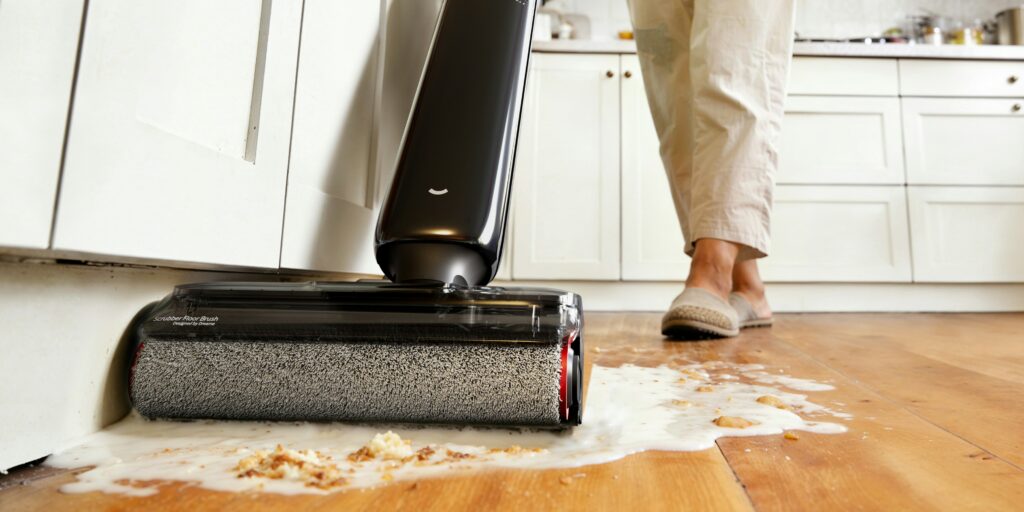
Hardwood floors don’t hide dust and debris the way carpet does — every crumb, hair, and dust bunny is visible on a clean wood surface. But the wrong vacuum can do real damage: stiff bristle brush rolls and hard plastic wheels can leave fine scratches that dull a finish over years of use. The right vacuum cleans effectively without putting your floors at risk.
This guide covers what actually matters when choosing a vacuum for hardwood — starting with brush roll design, which matters more than raw suction power — along with the main vacuum types worth considering.
The Most Important Factor: Brush Roll Design
For hardwood floors, brush roll material matters more than suction power. Vacuums designed for deep carpet cleaning often use stiff nylon or plastic bristles that grip carpet fibers effectively but can scratch a hardwood finish over repeated passes. A soft roller — typically made from felt, microfiber, or soft woven material — picks up fine dust and debris from hardwood without bristle contact that could mark the surface.
A simple check: if a brush roll feels stiff or bristly enough to notice against your palm, it’s more likely to be designed for carpet than hardwood. Many modern cordless vacuums now include a dedicated soft-roller head specifically for hard floors, separate from a stiffer carpet head — using the correct head for each surface matters.
Vacuum Types for Hardwood Floors
| Type | Best For | Consideration |
| Cordless Stick | Daily quick cleanups, light overall weight | Limited runtime (30-60 min typical) |
| Canister | Maximum suction, large homes | Corded; bulkier to maneuver |
| Robot | Hands-free daily maintenance | Can’t reach all edges or do stairs |
| Wet-Dry | Kitchens and spill-prone areas | Requires care on certain wood finishes |
Top Picks by Category
Best Overall Cordless: Dyson V15 Detect
The Dyson V15 Detect is frequently cited as a top performer for hardwood floors, largely due to its laser dust-detection system built into the cleaner head, which illuminates fine dust and debris that’s otherwise invisible on hard floors. It includes a soft roller head specifically designed for hardwood, separate from its carpet-focused heads, and a piezo sensor that adjusts suction automatically based on detected debris levels.
- Strengths: Laser dust detection, dedicated soft roller for hardwood, automatic suction adjustment, whole-machine HEPA filtration
- Trade-offs: Premium price; smaller dustbin requires more frequent emptying
Best Canister: Miele Complete C3 Line
Miele’s C3 canister vacuums are consistently recommended for hardwood floors, particularly for households prioritizing maximum suction and filtration. The included Parquet-style floor head uses natural bristles arranged to glide over hardwood without scratching, and Miele’s sealed HEPA AirClean filtration captures an exceptionally high percentage of fine particles — important on hardwood, where dust that escapes a vacuum’s exhaust settles visibly on the floor rather than staying trapped in carpet fibers.
- Strengths: Strong sustained suction (corded, no battery limits), dedicated hardwood floor head, sealed filtration, long-reported product lifespan
- Trade-offs: Corded limits mobility; heavier and bulkier than stick vacuums; premium pricing
Best Value: Shark Stratos and Similar Models
Shark’s Stratos and comparable cordless models are commonly recommended as strong value alternatives to premium Dyson models, often delivering a large share of the performance at a meaningfully lower price. Features like automatic suction adjustment (similar in concept to Dyson’s auto mode) and anti-allergen sealed filtration have become standard on Shark’s higher-end cordless lineup, along with dual-purpose brush heads that combine a soft roller section with a bristle section for transitioning between hardwood and carpet.
- Strengths: Strong value, automatic suction adjustment, dual-surface brush heads, sealed filtration on higher-end models
- Trade-offs: Slightly heavier than some premium cordless options; smaller dustbin capacity
Best Robot: Recent iRobot and Competing Models
Robot vacuums have become a popular daily-maintenance solution for hardwood floors, with rubber (rather than bristle) extractors on many current models reducing scratch risk during automated cleaning. Independent testing has found that navigation and obstacle avoidance — including around pets, cords, and furniture — have improved substantially in recent generations, and self-emptying bases mean a robot vacuum can run for weeks without manual intervention.
- Strengths: Fully automated, rubber extractors reduce scratch risk, improved navigation and obstacle avoidance, self-emptying options
- Trade-offs: Can’t reach all edges/corners as well as manual vacuums; can’t do stairs; works best alongside a manual vacuum rather than replacing one
Wet-Dry Vacuums: Useful, With Caveats
Wet-dry vacuums (like Tineco’s Floor One series or Bissell’s CrossWave line) vacuum and mop in a single pass, which can be genuinely convenient for kitchens and entryways where sticky spills are common. However, hardwood and water require care: excess moisture is one of the most common causes of warping, cupping, and staining in wood floors. These vacuums apply controlled amounts of water rather than soaking the floor, but they’re generally best suited to sealed hardwood with polyurethane or aluminum oxide finishes — and should be avoided on unfinished, oiled, or wax-finished wood, where moisture can penetrate more easily.
Features That Matter for Hardwood
Soft Roller or Hard-Floor Setting
The single most important hardwood-specific feature. A dedicated soft roller head, or a setting that disables the brush roll’s bristle action on hard floors, is the main defense against scratching.
Sealed HEPA Filtration
On carpet, fine dust gets trapped in fibers; on hardwood, escaped dust settles visibly on the floor within minutes. Sealed HEPA filtration — where the entire airflow path is gasketed to prevent air from bypassing the filter — keeps captured dust from drifting back out, which matters more on hardwood than on carpet.
Weight and Maneuverability
Hardwood is a slick surface, and a heavy vacuum can be more tiring to push around than the same weight would be on carpet (where fiber resistance helps stabilize the vacuum). For daily use, lighter cordless models under roughly 7 pounds are generally easier to maneuver for extended periods.
Rubber Wheels vs. Hard Plastic
Hard plastic wheels can pick up small grit and transfer it back onto the floor as scratches with repeated passes. Rubber or soft-coated wheels reduce this risk and are worth checking for, particularly on canister and upright models that roll directly across the floor.
Hardwood Floor Care Tips
- Use the lowest effective suction setting on hardwood — excessive suction can cause a lightweight vacuum to “stick” to the floor and become harder to maneuver, and can also scatter lightweight debris before the roller captures it
- Empty the dustbin regularly — an overfull bin reduces suction and can cause debris to be pushed around rather than picked up
- Check and clean wheels/casters periodically — grit embedded in wheels can scratch floors over repeated passes
- Keep felt pads on furniture legs fresh — no vacuum compensates for scratches caused by furniture being dragged across the floor
- If using a wet-dry vacuum, avoid letting water sit on the floor, and never use one on unfinished, oiled, or wax-finished wood
- A daily robot vacuum pass can help prevent the gradual buildup of grit that causes scratching under foot traffic over time
Frequently Asked Questions
Can I use a regular vacuum on hardwood floors?
You can, but vacuums designed primarily for carpet often have stiff bristle brush rolls that can scratch hardwood finishes over time, and they may push fine debris around on hard floors rather than picking it up effectively. Look for a vacuum with a soft roller head or a setting that disables the brush roll’s bristle action for hard floors.
Is a robot vacuum good enough for hardwood floors?
Robot vacuums handle daily maintenance on hardwood well, picking up dust, crumbs, and pet hair effectively with rubber extractors that minimize scratch risk. They typically can’t reach every edge and corner as thoroughly as a manual vacuum and can’t do stairs, so many households pair a daily robot vacuum with a weekly manual session.
How often should I vacuum hardwood floors?
High-traffic areas benefit from vacuuming several times a week; lower-traffic rooms can be vacuumed weekly. Households with pets generally benefit from more frequent vacuuming, since grit and dander left on hardwood can act like fine sandpaper under foot traffic over time.
Are cordless vacuums powerful enough for hardwood floors?
Yes — hardwood generally requires less suction than carpet, since debris sits on the surface rather than becoming embedded in fibers. Modern cordless vacuums provide more than enough suction for hardwood, and their convenience often leads to more frequent cleaning, which is itself beneficial for floor care.
What should I look for in a hardwood floor vacuum?
Prioritize a soft roller or hard-floor brush setting, rubber (not hard plastic) wheels, sealed HEPA filtration to prevent dust from settling back onto the floor, and a lightweight design for easier maneuvering. Good edge-cleaning performance along baseboards is also valuable, since dust tends to accumulate there.
Can steam mops or wet-dry vacuums damage hardwood floors?
Steam and excess moisture can damage certain hardwood finishes — generally safe on sealed polyurethane or aluminum oxide finishes, but risky on wax, oil, or unfinished wood, where moisture can penetrate and cause warping or discoloration. Always check your specific flooring’s finish before using any wet-dry or steam-based cleaning device.
Final Thoughts
For hardwood floors, the brush roll is the feature that matters most — a soft roller or dedicated hard-floor setting protects your finish far more than chasing the highest suction number. Beyond that, sealed filtration keeps dust from settling back onto a clean floor, and a lightweight design makes daily vacuuming less of a chore. Whether you choose a premium cordless model, a powerful canister, or a robot vacuum for daily maintenance, matching the vacuum’s brush design to your floor type is the single decision that protects your investment long-term.