
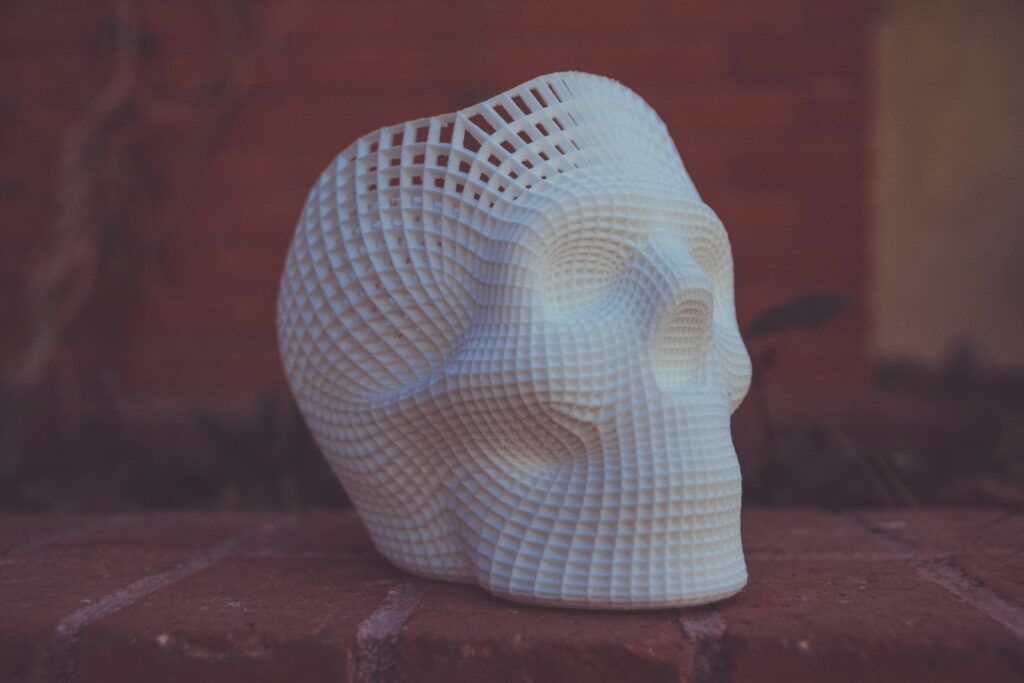
3D printing hasn’t replaced foam work, sewing, or hand-sculpting in cosplay – but it’s changed what’s possible, especially for pieces that are too symmetrical, too detailed, or too geometric to shape neatly by hand. Helmets, masks, armor pieces, and decorative props are now some of the most popular things to 3D print for conventions and costumes. Here’s how the process works, from printing through to a convention-ready finish.
What Works Well as a 3D Printed Cosplay Piece
3D printing tends to shine for specific problems within a larger costume rather than entire outfits built from scratch. Common candidates include:
- Helmets and masks: Full or partial face coverings, often printed in sections and assembled
- Armor pieces: Chest plates, pauldrons, gauntlets, and similar rigid components
- Decorative props: Belt buckles, badges, wrist devices, and other small details that are too symmetrical or geometric for foam or clay
- Display weapons and props: Decorative swords, staffs, and similar items – printed as lightweight display pieces rather than functional blades
- Chainmail and articulated pieces: Print-in-place chainmail designs that produce flexible, interlocking links without any assembly
Printer and Settings Considerations
For larger pieces like full helmets, build volume becomes a real factor – a large format printer can print a helmet in one piece rather than splitting it into multiple sections, reducing the number of seams that need sanding and gluing afterward. That said, plenty of impressive cosplay work comes from standard-size printers; most full helmets and armor sets are printed in multiple sections regardless, simply because very few printers have a build volume large enough for an entire helmet in one piece.
For layer height, around 0.2mm is a common sweet spot for armor and helmets – finer layers add print time without much visible benefit once sanding and filling happen anyway, while coarser layers mean more smoothing work. For small, highly detailed props with fine text or intricate features, dropping to 0.12-0.16mm in those specific areas can preserve detail that would otherwise be lost.
Print orientation matters for strength, not just appearance. Armor pieces print stronger when oriented so layer lines run across stress points rather than along them – a helmet printed standing straight up is generally weaker than one printed at an angle where the layer lines cross the areas most likely to flex or take an impact.
3D Scanning for Custom Fit
3D scanning has become a useful companion tool for cosplay, particularly for armor that needs to fit a specific body. Scanning a body part (or an existing costume piece) creates a digital reference that can be used to scale or modify a printed design for a proper fit, rather than relying purely on guesswork or repeated test prints. Combining 3D scanning with 3D printing is increasingly common for armor that needs to follow body contours closely – chest pieces, gauntlets, and similar fitted components benefit most from this approach.
The Finishing Workflow: From Raw Print to Convention-Ready
This is where the real transformation happens – a raw 3D print looks unmistakably like a 3D print, with visible layer lines and support marks. Professional-looking cosplay pieces get there through a fairly consistent finishing sequence:
1. Sanding
Sand perpendicular to the layer lines (across them, not along them) for the most effective smoothing. Start with coarse sandpaper – 120 to 200 grit – to knock down the most obvious ridges, then work progressively through finer grits (220, 320, 400) for a smooth final surface. For curved surfaces, wrapping sandpaper around a sponge or dowel helps maintain consistent pressure. Wet sanding (with water) reduces dust significantly and helps prevent sandpaper from clogging with plastic dust.
2. Filler Primer
Once major layer lines are knocked down, a few light coats of filler primer (in a ventilated space) fill in smaller imperfections that sanding alone can’t fully smooth out. After the primer cures, a lighter sanding pass with fine-grit paper (around 400) over the primed surface reveals any remaining flaws before painting – and these can be addressed with another light primer coat if needed.
3. Painting
Acrylic paints are the most common choice for 3D printed props, but checking that a specific paint adheres well to the printed material (PLA vs. PETG vs. resin can behave differently) avoids adhesion problems down the line. For weathering effects – a popular cosplay technique – painting a metallic base coat under the main color, then gently sanding edges once the top coat dries, reveals the “metal” underneath in a way that mimics realistic wear patterns.
4. Sealing
A clear coat sealant over finished paintwork protects it from the wear and tear of convention floors, handling, and photos – an easily-skipped step that makes a real difference in how well a finished piece holds up over multiple events.
Electroplating: Adding a Metallic Finish
For props that need a genuinely metallic look and feel rather than just metallic-colored paint, electroplating is an option that’s become more accessible to hobbyists. The process involves applying a conductive coating to the printed part, then using an electroplating setup to deposit a thin layer of actual metal (commonly copper or nickel) onto the surface. This produces a result that looks and feels distinctly different from painted finishes – genuinely metallic rather than metallic-appearing – though it adds a meaningfully more involved (and chemical-heavy) step to the finishing process compared to sanding and painting alone.
Assembly: Joining Multi-Part Prints
Most cosplay pieces are too large to print in one go – a helmet might be eight separate sections, and a full armor set could be dozens of pieces. How those pieces get joined matters for both strength and finish quality:
- Super glue (CA glue): Fast and convenient for temporarily tacking pieces into position, but can leave white residue on visible surfaces – better for positioning than final bonds
- Heat welding: For PLA, using a soldering iron or wood-burning tool to literally melt pieces together along the seam (working from the inside so the visible surface stays clean) produces a stronger, more permanent bond than glue
- Plastic bonders or UV resin: PETG is notably harder to glue than PLA – two-part plastic bonders or UV resin work better for PETG assemblies than standard super glue
Practical Design Considerations
A few details that don’t show up in renders but matter on the day: helmets often need hidden ventilation (wearing an enclosed printed helmet for hours without airflow gets uncomfortable fast), large props may need to be hollow or split into sections for transport even if they could theoretically print as one piece, and decorative elements that attach to fabric or other costume parts often work better with magnets or flexible straps than permanent glue – both for adjustability and for making the piece easier to pack and travel with.
Outsourcing: When a Print Service Makes Sense
For particularly large pieces, or for finishes that are hard to achieve with a desktop FDM printer, professional 3D printing services specializing in cosplay offer processes like MJF (nylon) and SLA resin printing, which produce tighter tolerances and smoother surfaces than typical desktop FDM – reducing or eliminating the hours of layer-line sanding that desktop prints usually require. These services often offer finish options like vapor polishing (a near-injection-molded surface ready for minimal-prep painting) or dyeing (permanent color without painting at all). For oversized pieces that won’t fit a single desktop build volume, these services can also advise on optimal split points to minimize visible seams during assembly.
Print-in-Place Chainmail: How It Works
Chainmail is one of the more clever applications of print-in-place design for cosplay. Rather than printing and assembling hundreds or thousands of individual links by hand – which would be enormously time-consuming – print-in-place chainmail designs print an entire interlocking mesh as a single piece, with small gaps built into the model that allow each ring to move independently once printed. The result comes off the printer already flexible and wearable, draping similarly to traditional chainmail despite being plastic rather than metal.
These designs tend to print best in a flexible filament like TPU for genuine drape and movement, though rigid filaments like PLA can also work for chainmail that’s meant to look the part without needing to move much – a costume collar or decorative panel, for instance, versus a full sleeve that needs to flex with arm movement. As with other print-in-place designs, getting the gap tolerances right depends on the printer’s calibration, so following a tested model’s recommended settings (rather than a model’s defaults blindly) helps avoid a chainmail piece that prints as one fused, immovable block.
Choosing Materials for Cosplay Pieces
PLA remains the most common choice for cosplay props and armor, mainly because it’s easy to print, holds detail well, and – critically for cosplay – sands and primes predictably, which matters enormously once the finishing workflow begins. PETG offers more durability for pieces that will take real impacts or rough handling at conventions, at the cost of being somewhat harder to sand smoothly and, as covered above, trickier to glue.
For armor or props that need to flex – a chest piece that needs to curve with the body, or a prop that needs to survive being sat on or packed into a bag – a combination approach is common: rigid PLA or PETG for the main structural shape, with flexible TPU sections at stress points or high-flex areas. This kind of mixed-material approach is one of the areas where multi-material printers (covered in our filament guide) genuinely pay off for cosplay builds specifically, since swapping filaments mid-print for different sections of the same piece would otherwise mean printing in separate parts and joining them afterward.
Realistic Time Expectations
It’s worth setting expectations honestly: the printing itself is often the smallest part of a cosplay build’s total time investment. A helmet that takes 20-30 hours to print across its sections might take another 10-20 hours of sanding, priming, and painting before it’s convention-ready – and that’s before accounting for assembly, any scanning/fitting iterations, or attaching the piece to the rest of a costume. For anyone planning a cosplay build around a specific convention date, working backward from that date with generous time for finishing – not just printing – tends to be the difference between a relaxed build and a last-minute scramble.
Frequently Asked Questions
What’s the best layer height for 3D printed cosplay armor?
Around 0.2mm is a common balance for armor and helmets – finer layers add print time without much benefit since sanding and filling happen regardless, while coarser layers mean more smoothing work. Small detailed props can drop to 0.12-0.16mm in specific areas to preserve fine detail.
How do I get a smooth finish on a 3D printed helmet?
Sand perpendicular to the layer lines, working from coarse grit (120-200) up through finer grits (220-320-400), then apply filler primer in light coats, sand again lightly once cured, and repeat if needed before painting.
Can I 3D print a full cosplay helmet in one piece?
Only with a large format printer with sufficient build volume – most helmets are printed in multiple sections (sometimes eight or more) and assembled afterward, regardless of printer size, since very few machines have a build volume large enough for a full helmet.
What’s the best way to glue 3D printed parts together?
For PLA, heat welding with a soldering iron (working from the inside) creates the strongest bond. Super glue works for temporary positioning but can leave residue. PETG is harder to glue than PLA and benefits from two-part plastic bonders or UV resin.
What is electroplating for 3D prints?
Electroplating applies a conductive coating to a printed part, then deposits a thin layer of actual metal (often copper or nickel) onto the surface – producing a genuinely metallic finish rather than metallic-colored paint, at the cost of a more involved, chemical-based process.
Final Thoughts
The gap between a raw 3D print and a convention-ready cosplay piece comes down almost entirely to finishing – sanding, priming, painting, sealing, and (for multi-part builds) careful assembly. Getting the printing settings right (orientation for strength, appropriate layer height) sets up an easier finishing process, but it’s the sanding-to-painting workflow where most pieces go from “obviously 3D printed” to something that looks like it belongs on a movie set. For anyone just starting out, a small prop or accessory piece is a much more forgiving place to learn this workflow than diving straight into a full helmet or armor set.