
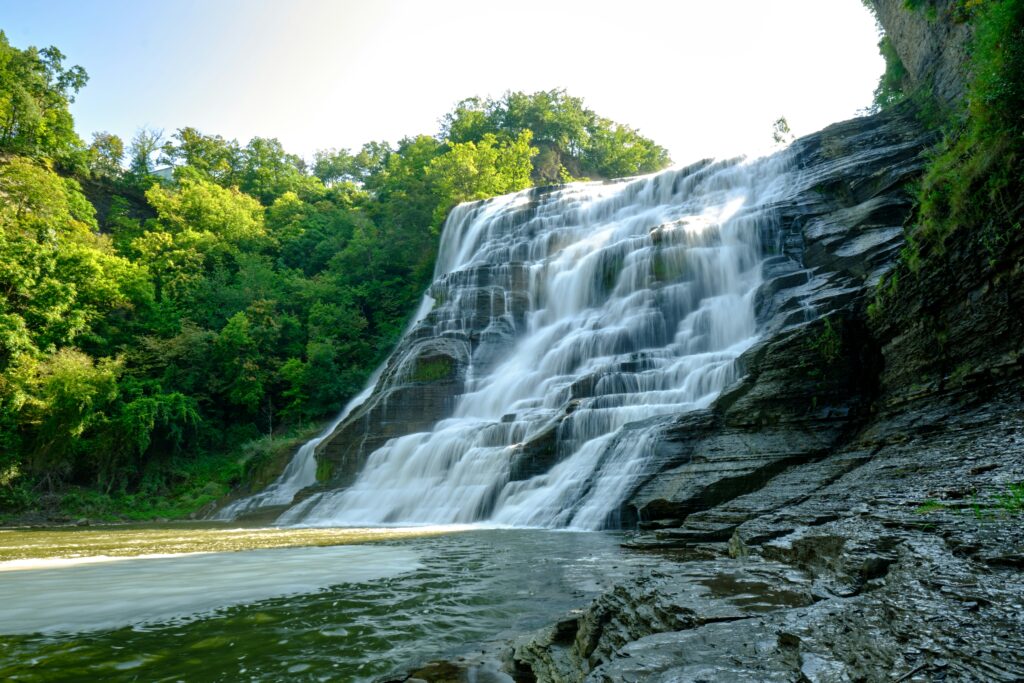
Ithaca’s unofficial town motto is “Ithaca is Gorges” — and the pun holds up. The city sits at the southern tip of Cayuga Lake in New York’s Finger Lakes region, surrounded by deep glacial gorges where streams drop hundreds of feet on their way to the lake. Within a 30-minute radius of downtown Ithaca, you can visit waterfalls ranging from a 55-foot cascade on the Cornell University campus to a 215-foot single-drop falls that rivals anything on the East Coast.
This guide covers the 8 best waterfalls near Ithaca, NY, with trail distances, parking details, and what makes each one worth the visit. Most of these falls require minimal hiking — many are visible within a 10 to 20 minute walk from the parking area, making this one of the most rewarding short-hike waterfall regions in the eastern United States.
Best Waterfalls Near Ithaca: Quick Comparison
| Waterfall | Height | Trail Distance | Fee | Best For |
| Ithaca Falls | 150 ft | Roadside, no hike | Free | |
| Taughannock Falls | 215 ft | 1.8 mi round trip (flat) | NY State Parks fee | |
| Buttermilk Falls (Lower) | 165 ft total cascade | Visible from parking; 1.6 mi loop trail | NY State Parks fee | |
| Lucifer Falls (Treman) | 115 ft | ~1.5 mi to falls (steeper) | NY State Parks fee | |
| Lower Falls (Treman, Enfield Glen) | ~40 ft | Short gravel path from lot | NY State Parks fee | |
| Triphammer Falls | 55 ft | On Cornell campus, no hike | Free | |
| Forest Falls / Cascadilla Gorge | ~35 ft (multiple drops) | Cascadilla Gorge Trail (steep) | Free | |
| Watkins Glen waterfalls | ~19 falls along gorge | 2 mi one-way Gorge Trail | NY State Parks fee |
1. Ithaca Falls — The Most Accessible Waterfall in Town
Ithaca Falls is the easiest waterfall to visit near downtown Ithaca, requiring essentially no hiking at all. At 150 feet tall, it is one of the largest waterfalls within city limits anywhere in the United States, and it carries genuine local history — the falls once powered a series of mills and factories during Ithaca’s industrial era, with foundation ruins still visible in the surrounding Ithaca Falls Natural Area.
The viewing area sits just south of Cornell University, a short walk from a small parking area on Lake Street. Because the falls are visible almost immediately from the parking area, Ithaca Falls works well as a quick stop for visitors with limited time, or as the first or last stop on a longer Ithaca waterfall day.
Entry: free. Parking is limited and fills up on weekends — arriving early in the day improves your chances of a close spot.
2. Taughannock Falls — Taller Than Niagara
Taughannock Falls is the single most spectacular waterfall in the Ithaca area, and one of the tallest single-drop waterfalls in the eastern United States at 215 feet — taller than Niagara Falls by more than 30 feet, even though the water volume is far smaller. The falls drop in one continuous plunge into a natural amphitheater carved into the surrounding shale cliffs, creating a setting that genuinely feels larger than typical East Coast waterfalls.
The trail to the base of the falls is flat and well-maintained, running 1.8 miles round trip along Taughannock Creek. The trail is accessible for most fitness levels and is stroller-friendly for much of its length, which makes this one of the most family-accessible major waterfalls in the region. Photos consistently undersell the scale of Taughannock — standing at the base and feeling the spray and the sound of 215 feet of falling water is a different experience entirely.
Taughannock Falls State Park also includes a separate rim trail with overlook views from above the gorge, a swimming area on Cayuga Lake (seasonal, with lifeguards), and camping facilities. Entry requires a New York State Parks day-use fee or an Empire Pass.
3. Buttermilk Falls State Park
Buttermilk Falls, located just south of downtown Ithaca, is a multi-tiered cascade with a total drop of roughly 165 feet through a series of stepped falls and pools — the name comes from the frothy, churned appearance of the water as it cascades over each tier. The lower falls and main pool are visible directly from the parking area, making this one of the easiest major waterfalls to view with zero hiking required.
For a more complete experience, cross the small bridge at the base and take the trail up the right side of the gorge — this reveals upper sections of the falls invisible from the parking lot, and connects to the full 1.6-mile loop trail that climbs to the top of the gorge and back down. The trail is moderately challenging with stone stairs in sections but manageable for most hikers.
Buttermilk Falls has a designated swimming area at the base of the lower falls (seasonal, lifeguarded) — one of the few legal swimming spots at an Ithaca-area waterfall, making it popular on hot summer days. Entry requires a New York State Parks day-use fee or Empire Pass.
4. Lucifer Falls — Robert H. Treman State Park
Robert H. Treman State Park, just south of Ithaca, contains Enfield Glen — a gorge with multiple waterfalls, the most dramatic of which is Lucifer Falls, a 115-foot cascade near the park’s upper entrance. The gorge trail through Treman is widely considered one of the most scenic short hikes in the Finger Lakes, descending through a narrow, fern-covered canyon with multiple smaller cascades visible along the way before reaching the main falls.
The full Gorge Trail through Treman connects the upper and lower areas of the park and includes some steep sections and stone staircases, so allow more time than the distance alone suggests — roughly 1.5 miles to reach Lucifer Falls from the upper entrance, with meaningful elevation change.
Entry requires a New York State Parks day-use fee or Empire Pass.
5. Lower Falls — Robert H. Treman State Park
The Lower Falls section of Treman State Park, accessed from a separate entrance from Lucifer Falls, offers one of the easiest and most pleasant waterfall experiences in the Ithaca area. A short gravel path leads from a large parking lot directly to the base of the falls, where a wide gravel area provides ample space for a picnic with a direct view of the cascading water.
The pool at the base of the Lower Falls is a popular informal swimming spot, though it is not an officially lifeguarded swimming area like Buttermilk Falls — swim at your own discretion and judgment of current conditions. The minimal hiking distance and picnic-friendly setup make this one of the best options for families with young children or visitors who want a waterfall experience without a strenuous hike.
Entry requires a New York State Parks day-use fee or Empire Pass (same park system as Lucifer Falls, accessible via the same park).
6. Triphammer Falls — Cornell University Campus
Triphammer Falls sits directly on the Cornell University campus, upstream from Ithaca Falls along Fall Creek. At 55 feet, it is the smallest waterfall on this list, but its location makes it uniquely convenient — visible from campus walkways with zero dedicated hiking required, making it an easy add-on for anyone already exploring Cornell or visiting Ithaca Falls nearby.
The falls take their name from a historic forge that operated alongside the cascade for many years, using the water’s power for industrial purposes — another example of how deeply the Ithaca area’s waterfalls are tied to the region’s 19th-century industrial history. Entry is free.
7. Cascadilla Gorge Trail — Downtown to Cornell
The Cascadilla Gorge Trail offers something different from the other entries on this list: rather than a single dramatic waterfall, it is a series of cascades and pools along a gorge trail that connects downtown Ithaca directly to the Cornell University campus. The trail climbs roughly 400 feet in elevation over about a mile, passing multiple smaller waterfalls and swimming holes along stone steps and footbridges built into the gorge walls.
This trail is genuinely unique as a piece of urban-adjacent infrastructure — few American college towns have a waterfall gorge trail serving as a practical walking route between downtown and campus. It can be steep and the stone steps become slippery when wet, so appropriate footwear matters more here than on the flatter trails at Taughannock. Entry is free.
8. Watkins Glen State Park — Worth the Drive
Watkins Glen sits 24 miles west of Ithaca at the southern tip of Seneca Lake, and while it is technically outside the immediate Ithaca area, it is close enough — and spectacular enough — to be worth including on any Ithaca-area waterfall trip. The Gorge Trail winds past approximately 19 waterfalls over a 2-mile stretch, following a stone walkway, tunnels, and bridges carved directly into the gorge walls during the 1930s by the Civilian Conservation Corps.
Watkins Glen is widely considered one of the most photogenic gorge trails in the United States, and the stone pathway architecture is genuinely unlike anything else in the Finger Lakes waterfall circuit. If you have a full day or weekend in the Ithaca/Finger Lakes area, the drive to Watkins Glen is well worth it as a complement to the closer Ithaca falls. Entry requires a New York State Parks day-use fee or Empire Pass.
Tips for Visiting Waterfalls Near Ithaca
Get the New York State Parks Empire Pass
Most of the waterfalls on this list — Taughannock, Buttermilk, Treman, and Watkins Glen — are New York State Parks and each charge a day-use parking fee, typically around $10 per vehicle. If you plan to visit multiple parks in a single trip, or if you expect to visit any other New York State Parks throughout the year, the Empire Pass at roughly $80 per year pays for itself after about 8 park visits and provides unlimited access to all New York State Parks for the calendar year.
Visit in different seasons for a completely different experience
Ithaca’s waterfalls genuinely transform across seasons. Summer brings full green canopy and the most water volume after spring snowmelt feeds the creeks; fall foliage frames the gorges in color through October; and winter freezes sections of the falls into dramatic ice formations, particularly at Buttermilk and Treman, where ice climbers sometimes use the frozen cascades. Each season rewards a different kind of visit, and many repeat visitors specifically return in winter for the ice formations alone.
Bring a picnic
Most of the waterfalls in this guide require minimal hiking, and several — Ithaca Falls, Lower Falls at Treman, the base of Buttermilk Falls — have flat gravel or grass areas suitable for sitting and spending real time at the falls rather than a quick photo stop. Bringing a picnic or snacks extends the visit meaningfully and is a genuinely pleasant way to experience these spots beyond a 10-minute photo opportunity.
Check trail and swimming conditions before visiting
Trail closures and swimming restrictions can change seasonally and after heavy rain — gorge trails are particularly prone to closure following storms due to rockfall risk and slippery conditions. Check the New York State Parks website for current conditions at Taughannock, Buttermilk, and Treman before driving out, particularly outside peak summer season.
Wear appropriate footwear
Several of these trails — particularly Lucifer Falls at Treman and the Cascadilla Gorge Trail — involve stone steps that become slippery when wet. Sturdy footwear with good tread is strongly recommended over sandals or smooth-soled shoes, especially if visiting after rain or in early spring when trails can still be muddy from snowmelt.
For a complete dedicated guide to visiting Taughannock Falls State Park, see our Taughannock Falls visitor guide.
For current park hours, fees, and trail conditions, see the official New York State Parks website for Taughannock Falls, Buttermilk Falls, Robert H. Treman, and Watkins Glen State Parks.
Source: New York State Parks hiking guide.
Related Guides
See also: Best fall hikes upstate New York.
Source: New York State Parks official site.
Bottom Line
| Easiest waterfall to visit | Ithaca Falls — roadside view, no hiking, free entry |
| Tallest and most dramatic | Taughannock Falls — 215 feet, taller than Niagara, 1.8 mi flat trail |
| Best for swimming | Buttermilk Falls — lifeguarded swimming area at the base |
| Best easy/family option | Lower Falls at Treman — short gravel path, picnic area |
| Most dramatic gorge scenery | Lucifer Falls at Treman — steep, narrow fern-covered canyon |
| Best free campus option | Triphammer Falls or Cascadilla Gorge Trail — both free, on/near Cornell |
| Worth the extra drive | Watkins Glen — 24 miles away, ~19 waterfalls along a 2-mile stone trail |
| Pass to buy if visiting multiple parks | NY State Parks Empire Pass (~$80/year, pays off after 8 visits) |
| Best season for ice formations | Winter — Buttermilk and Treman freeze into dramatic ice cascades |
Frequently Asked Questions
What is the best waterfall to visit near Ithaca, NY?
Taughannock Falls is widely considered the best and most dramatic waterfall near Ithaca, NY, dropping 215 feet in a single plunge — taller than Niagara Falls. The trail to the base is a flat, accessible 1.8-mile round trip. For a quicker, no-hike option close to downtown, Ithaca Falls (150 feet) is the most convenient, with viewing possible just steps from the parking area.
Is Ithaca Falls free to visit?
Yes, Ithaca Falls is free to visit. It is located in the Ithaca Falls Natural Area, just south of Cornell University, with public parking nearby on Lake Street. Unlike Taughannock Falls, Buttermilk Falls, and Robert H. Treman State Park, which are New York State Parks requiring a day-use fee, Ithaca Falls does not charge admission.
How many waterfalls are there in Ithaca, NY?
The Ithaca area, including the broader Finger Lakes region within a 30-minute drive, has well over a dozen significant named waterfalls. Within Ithaca’s immediate vicinity, the major falls include Ithaca Falls, Triphammer Falls, Taughannock Falls, Buttermilk Falls, Lucifer Falls and Lower Falls in Robert H. Treman State Park, and the multiple cascades along Cascadilla Gorge. Watkins Glen State Park, 24 miles away, adds approximately 19 more waterfalls along its famous Gorge Trail.
Can you swim at the waterfalls near Ithaca?
Yes, at select locations. Buttermilk Falls State Park has an official, seasonally lifeguarded swimming area at the base of the lower falls — the most reliable legal swimming spot among Ithaca’s waterfalls. The Lower Falls area at Robert H. Treman State Park also has an informal swimming pool at its base, though it is not an officially lifeguarded area. Swimming at Ithaca Falls itself has historically occurred informally but is generally discouraged due to safety concerns; always check current park signage and conditions before swimming anywhere.
Do you need a pass to visit waterfalls near Ithaca?
Most of the major waterfalls near Ithaca — Taughannock Falls, Buttermilk Falls, and Robert H. Treman State Park — are New York State Parks and require a day-use parking fee, typically around $10 per vehicle, or a New York State Parks Empire Pass (approximately $80 per year for unlimited access to all state parks). Ithaca Falls, Triphammer Falls, and the Cascadilla Gorge Trail are free to visit, as they are not located within a fee-charging state park.
What is the easiest waterfall hike near Ithaca?
Ithaca Falls requires no hiking at all — the falls are visible essentially from the parking area. For waterfalls within a state park, Taughannock Falls offers the easiest meaningful trail at 1.8 miles round trip on flat, well-maintained terrain suitable for strollers and most fitness levels. The Lower Falls area of Robert H. Treman State Park is similarly easy, with a short gravel path connecting the parking lot directly to the base of the falls.