
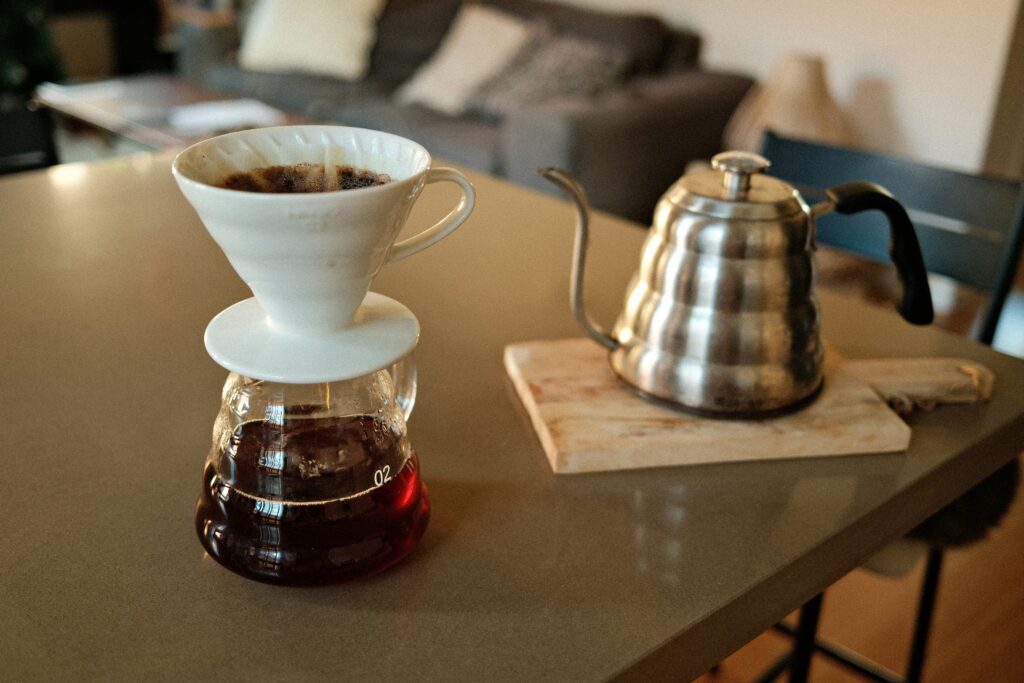
Pour over coffee produces a cleaner, brighter, more nuanced cup than any automatic drip machine — and the equipment to get started costs less than most people expect. The manual brewing process gives you complete control over every variable: water temperature, pour rate, brew time, and coffee-to-water ratio. That control is why specialty coffee shops have been using pour over brewers for decades and why home coffee enthusiasts keep returning to them once they experience the difference.
This guide covers the best pour over coffee makers available in 2025 — from the easiest options for beginners to the most precise tools for enthusiasts — with honest assessments of what each brewer delivers and what gear you actually need to get started.
Best Pour Over Coffee Makers: Quick Reference
| Brewer | Difficulty | Price | Capacity | Best For |
| Hario V60 | Medium | ~$25–45 | 1–4 cups | Best overall; control and clarity |
| Kalita Wave | Easy | ~$35–55 | 1–4 cups | Best for beginners; forgiving |
| Chemex | Medium | ~$45–55 | 3–10 cups | Best for multiple cups; clean and elegant |
| Origami Dripper | Medium-Hard | ~$60–100 | 1–3 cups | Best for enthusiasts; most versatile |
| Melitta Pour Over | Easy | ~$10–15 | 1–6 cups | Best budget option; beginner-friendly |
| Fellow Stagg [X] | Medium | ~$65 | 1–4 cups | Best premium single-cup; temperature control |
Best Pour Over Coffee Makers: Detailed Reviews
1. Hario V60 — Best Overall Pour Over Coffee Maker
Difficulty: Medium | Price: ~$25–45 | Material: Ceramic, glass, plastic, or metal options | Capacity: 1–4 cups
The Hario V60 is the most widely used pour over dripper in specialty coffee shops worldwide and the standard against which other drippers are measured. The V60’s design — a 60-degree cone with spiral ribs along the inside walls and a large single drainage hole at the bottom — provides maximum flow control. The spiral ribs hold the paper filter away from the cone walls, allowing air to escape and enabling consistent water flow. The large drainage hole means the brewer itself doesn’t restrict flow — everything depends on your technique and grind size.
This design gives experienced brewers extraordinary control over the cup: adjust your pour rate and you adjust extraction. Grind finer for a richer, heavier cup; coarser for a lighter, more delicate brew. The V60 rewards skill and punishes mistakes, which is why it has a slightly steeper learning curve than the Kalita Wave — but it’s not nearly as difficult as some coffee forums suggest. With a gooseneck kettle, medium grind, and a simple two-pour technique (bloom pour plus main pour), most people produce excellent V60 coffee within a few attempts.
The Hario V60 comes in ceramic, glass, metal, and plastic versions at different price points. The plastic version at approximately $10 is an underrated starting point — it’s lightweight, durable, and brews identically to the ceramic version while being much more travel-friendly. The ceramic version retains heat better and is the most widely sold. Hario also makes an excellent starter kit that includes the dripper, a glass carafe, and filters.
- Best for: Anyone willing to practice; the highest potential ceiling for cup quality in this price range
- Requires: Gooseneck kettle strongly recommended; scale recommended but not essential
- Filters: Hario VCF-01 (1–2 cups) or VCF-02 (1–4 cups) — widely available at coffee shops and online
2. Kalita Wave — Best Pour Over for Beginners
Difficulty: Easy | Price: ~$35–55 | Material: Stainless steel or glass | Capacity: 1–4 cups
The Kalita Wave is the most forgiving pour over dripper available — its flat-bottomed design with three small drainage holes (versus the V60’s single large cone hole) creates consistent flow restriction that makes the brewing process much more forgiving of imprecise technique. The wave-crimped filter (which gives the brewer its name) holds the paper away from the flat bottom, promoting even extraction across the entire bed of coffee grounds.
In practice, the Kalita Wave means you can pour water at different rates, be slightly imprecise with your timing, or use a slightly inconsistent grind and still produce good coffee. The V60 in the same scenario would produce noticeably inconsistent results. This makes the Wave the clear recommendation for beginners who don’t want to invest in a gooseneck kettle and scale immediately — you can get solid results with a regular kettle and a coffee measure.
The main practical consideration: Kalita Wave filters (the distinctive wavy crimped paper) are less widely available in grocery stores than standard cone filters. They’re easy to order online and available at most coffee shops that stock pour over gear, but if you run out mid-morning you can’t just grab a replacement at the supermarket. Stock up.
- Best for: Beginners; people who want consistent results with minimal gear investment
- Does not require: Gooseneck kettle (though it helps); scale (though it helps)
- Filter note: Kalita Wave 155 (1–2 cups) or Wave 185 (2–4 cups) — order online; not always in stores
3. Chemex — Best Pour Over for Multiple Cups
Difficulty: Medium | Price: ~$45–55 | Material: Borosilicate glass | Capacity: 3, 6, 8, or 10 cups
The Chemex is the most visually iconic pour over coffee maker — a single piece of hourglass-shaped borosilicate glass with a wooden collar that has appeared in New York’s Museum of Modern Art and became a design icon long before the specialty coffee movement adopted it. But the Chemex is not just beautiful: it brews a remarkably clean, bright, and balanced cup thanks to its thick proprietary filters that remove more oils and fine particles than standard paper filters.
The Chemex is the right choice for anyone who regularly brews for two to four people. The 6-cup version (which actually brews approximately 3 standard coffee cups) is the most popular and practical. The thick filters produce the cleanest cup available in pour over brewing — noticeably lighter and more delicate than V60 or Kalita Wave output, which makes it ideal for showcasing light and medium roast single origin coffees with floral or fruit character.
The Chemex uses its own proprietary filters (Chemex Natural and Chemex White paper filters) which are thicker than standard cone filters. These are available at most grocery stores that stock coffee supplies and widely online.
- Best for: Households brewing 2–4 cups at once; clean, bright cup style; aesthetic appeal
- Filter note: Chemex proprietary filters — available at most grocery stores
- The limitation: Chemex glass is fragile; the wooden collar requires occasional re-tying; filters are thicker and slower than standard cone filters
4. Origami Dripper — Best for Enthusiasts
Difficulty: Medium-Hard | Price: ~$60–100 | Material: Ceramic or plastic | Capacity: 1–3 cups
The Origami Dripper is the most versatile and technically interesting pour over dripper available — a Japanese-designed cone with distinctive ridged exterior that is compatible with both flat (Kalita Wave 185) and cone (V60-02) paper filters. This dual filter compatibility, combined with the Origami’s conical shape, makes it behave differently depending on which filter type you use: flat filters produce a fuller, rounder cup; cone filters produce a brighter, more dynamic extraction.
The Origami is for coffee enthusiasts who want to experiment with different filter types and extraction profiles from a single brewer. It is not for beginners — the technique sensitivity and the significant investment (ceramic versions run $80 to $100) make it an upgrade choice for experienced brewers rather than a starting point. The brewer requires a separate stand to sit over a cup or carafe.
- Best for: Experienced pour over enthusiasts; experimenters; specialty coffee lovers
- Requires: Separate stand; gooseneck kettle; scale
5. Melitta Pour Over — Best Budget Pour Over Coffee Maker
Difficulty: Easy | Price: ~$10–15 | Material: Plastic | Capacity: 1–6 cups
The Melitta is one of the original pour over coffee makers — the company invented the paper coffee filter in 1908 — and remains the most affordable and accessible pour over option available. The flat-bottomed design with a single small hole produces forgiving, consistent results that are genuinely good, not just passable. For anyone who wants to try pour over without committing significant money upfront, the Melitta is the logical starting point.
The Melitta uses standard #2 or #4 cone filters (depending on the size) that are available at virtually every grocery store in the US. This is a meaningful practical advantage — you will never run out of filters and be unable to brew.
- Best for: Budget-conscious starters; anyone trying pour over for the first time; travel brewing
- Filter note: Standard #2 or #4 cone filters — available everywhere
- The realistic ceiling: The Melitta’s single drainage hole limits flow control; you’ll outgrow it when you develop your technique, but it’s a fine starting point
6. Fellow Stagg [X] — Best Premium Single-Cup Pour Over
Difficulty: Medium | Price: ~$65 | Material: Stainless steel | Capacity: 1–2 cups
The Fellow Stagg [X] is the most refined single-cup pour over dripper in the premium market — a double-wall stainless steel design that retains heat better than ceramic or glass, with a ratio aid (measurement markings) built into the brewing vessel and a responsive flat bottom that produces consistent extraction. Fellow also makes the Stagg EKG gooseneck kettle, which pairs naturally with the [X] for a complete premium pour over setup.
The Stagg [X]’s double-wall construction means the brew temperature stays consistent throughout the extraction — an advantage over single-wall ceramics that lose heat quickly, particularly in cold environments. For serious single-cup brewing, the Stagg [X] produces an excellent and highly consistent cup. The $65 price point is a real investment for a single-cup dripper, but for committed pour over enthusiasts it’s a genuinely premium experience.
Essential Pour Over Equipment
Gooseneck Kettle — The Most Important Tool
A gooseneck kettle is the single most impactful piece of equipment for pour over coffee beyond the dripper itself. The long, narrow spout gives you precise control over the flow rate and direction of water — allowing you to pour in slow, controlled circles that saturate coffee grounds evenly. A standard kettle with a wide spout pours too fast and too imprecisely, making even extraction difficult.
The Fellow Stagg EKG is the most popular electric gooseneck kettle at approximately $165 — it maintains exact temperature control (essential for pour over at the correct 195–205°F range). For a more budget-friendly option, the Hario Buono gooseneck kettle at approximately $50 is a highly regarded stovetop option used in coffee shops worldwide. If you only buy one piece of pour over equipment beyond the dripper, make it a gooseneck kettle.
Coffee Scale — More Useful Than It Sounds
A digital coffee scale lets you measure both coffee grounds and water by weight rather than volume — producing repeatable, accurate results every time. Without a scale, you’re estimating by sight or using measuring spoons, which introduces variability that makes it hard to reproduce a great cup.
The ratio for pour over is typically 1:15 to 1:17 (1 gram of coffee per 15 to 17 grams of water). At a 1:15 ratio, 20 grams of coffee to 300 grams of water makes approximately one 10-ounce cup. A basic coffee scale runs $15 to $25 on Amazon; the Hario V60 Drip Scale is the most popular coffee-specific scale at approximately $55.
Coffee Grinder
Freshly ground coffee makes a noticeable difference in pour over quality — the volatile aromatic compounds in whole beans begin oxidizing immediately after grinding, and pre-ground coffee has typically lost significant freshness by the time you use it. For pour over, you need a medium grind (finer than drip coffee, coarser than espresso) that is consistent — no fine powder particles mixed with coarse chunks.
Burr grinders produce consistent, even particle sizes; blade grinders chop coffee inconsistently and create a mix of fine and coarse particles that extract unevenly. For budget-friendly pour over, the Baratza Encore burr grinder at approximately $175 is the most widely recommended entry-level electric option. Manual burr grinders (Hario Skerton, Porlex Mini) cost $30 to $70 and produce excellent results with the added effort of hand-cranking.
If you’re not ready to invest in a grinder: ask a local coffee shop to grind fresh beans for you at a medium setting when you buy them. Week-old professionally ground coffee brews better than fresh but unevenly ground coffee.
Pour Over Brewing Guide: The Basics
The fundamental pour over technique involves two stages: the bloom pour and the main pour.
- Water temperature: 195–205°F (just off boil — let boiling water sit for 30 seconds). Too cool and coffee under-extracts and tastes sour; too hot and it over-extracts and tastes bitter.
- Coffee-to-water ratio: 1:15 to 1:17 by weight. Start at 1:15 for a richer cup or 1:17 for a lighter cup. Adjust from there based on taste.
- Pre-wet the filter: Before adding coffee, rinse the paper filter with hot water. This removes the paper taste and preheats the brewer. Discard the rinse water.
- Bloom pour: Add coffee to the wet filter. Pour approximately twice the coffee’s weight in water (40g water for 20g coffee) and let it sit for 30 to 45 seconds. The coffee will bubble and ‘bloom’ as CO2 released from fresh beans escapes. This primes the grounds for even extraction.
- Main pour: After the bloom, add the remaining water in slow, circular pours. Pour in the center and spiral outward, keeping the water level consistent. Total brew time for 300ml should be approximately 2.5 to 3.5 minutes.
- Troubleshooting: If the brew is too fast (under 2 minutes), grind finer. If too slow (over 4 minutes), grind coarser. If too sour/weak, grind finer or increase coffee dose. If too bitter, grind coarser or decrease coffee dose.
V60 vs Kalita Wave vs Chemex: How to Choose
| Hario V60 | Kalita Wave | Chemex | |
| Difficulty | Medium | Easy | Medium |
| Cup style | Bright, complex, clean | Balanced, smooth | Very clean, delicate |
| Multiple cups | Possible with larger size | Possible with larger size | Best option for 3–4 cups |
| Filter availability | Wide | Limited in stores | Wide |
| Gooseneck needed? | Strongly recommended | Helpful but not essential | Recommended |
| Price | ~$25–45 | ~$35–55 | ~$45–55 |
| Best for | Enthusiasts and beginners willing to practice | Beginners wanting reliable results | Household brewing; visual elegance |
Frequently Asked Questions
What is the best pour over coffee maker?
The Hario V60 is the best overall pour over coffee maker for most people — it produces the widest range of cup profiles, is available at multiple price points ($10 for plastic to $45 for ceramic), and pairs with the most widely available filters. For beginners who want the easiest learning curve, the Kalita Wave is the better starting point. For households regularly brewing 3 or more cups, the Chemex is the most practical option.
Do you need a gooseneck kettle for pour over?
A gooseneck kettle is strongly recommended for the Hario V60 and any cone-shaped dripper — the controlled flow rate makes a noticeable difference in extraction consistency. For the Kalita Wave and Melitta, a regular kettle produces acceptable results because the flat-bottomed design is more forgiving of imprecise pouring. If you’re investing in pour over equipment, a gooseneck kettle is the single most impactful upgrade beyond the dripper.
Is pour over coffee better than drip coffee?
Pour over coffee typically produces a cleaner, brighter, and more nuanced cup than automatic drip coffee — because manual control over water temperature, pour rate, and timing allows more precise extraction. Automatic drip machines vary significantly in quality: entry-level machines rarely reach optimal brewing temperature (195–205°F) and distribute water inconsistently. SCAA-certified automatic drip machines (Technivorm Moccamaster, Breville Precision Brewer) can produce pour over-quality results automatically. For most home brewers, a V60 or Kalita Wave with fresh beans produces noticeably better coffee than a standard drip machine.
What grind size for pour over?
Medium grind — approximately the texture of granulated table salt. Finer than drip coffee grind; coarser than espresso. The correct grind for pour over depends on the specific dripper: the Hario V60 benefits from a slightly finer grind (the large drainage hole needs the ground bed to create flow resistance); the Kalita Wave works best slightly coarser (the restricted holes provide flow resistance). Start at medium and adjust based on brew time — if the water drains too quickly (under 2.5 minutes total), grind finer.
How much coffee do I use for pour over?
Start with a 1:15 coffee-to-water ratio by weight: 20 grams of coffee to 300 grams of water for one 10-ounce cup. Adjust to taste — more coffee (1:13 or 1:14 ratio) for a stronger cup, less (1:17 or 1:18) for a lighter cup. Using a kitchen scale is the most reliable way to maintain consistent ratios. Without a scale: approximately 2 level tablespoons of medium-ground coffee per 6 ounces of water is a reasonable starting point.
Final Thoughts
The best pour over coffee maker for you depends on one question: how much do you want to control the brewing process? The Hario V60 rewards practice and technique with the most expressive cup in pour over brewing. The Kalita Wave is easier and more forgiving without sacrificing much cup quality. The Chemex is the right choice when you regularly brew for multiple people and want the cleanest, most elegant result.
Start with whatever matches your gear investment comfort level — even a $10 Melitta with a gooseneck kettle produces better coffee than most automatic drip machines at ten times the price. Add a burr grinder when you’re ready to invest further. The pour over process itself takes less than 5 minutes once you know your routine — and the difference in cup quality compared to automatic drip makes it worth the small effort every morning.