
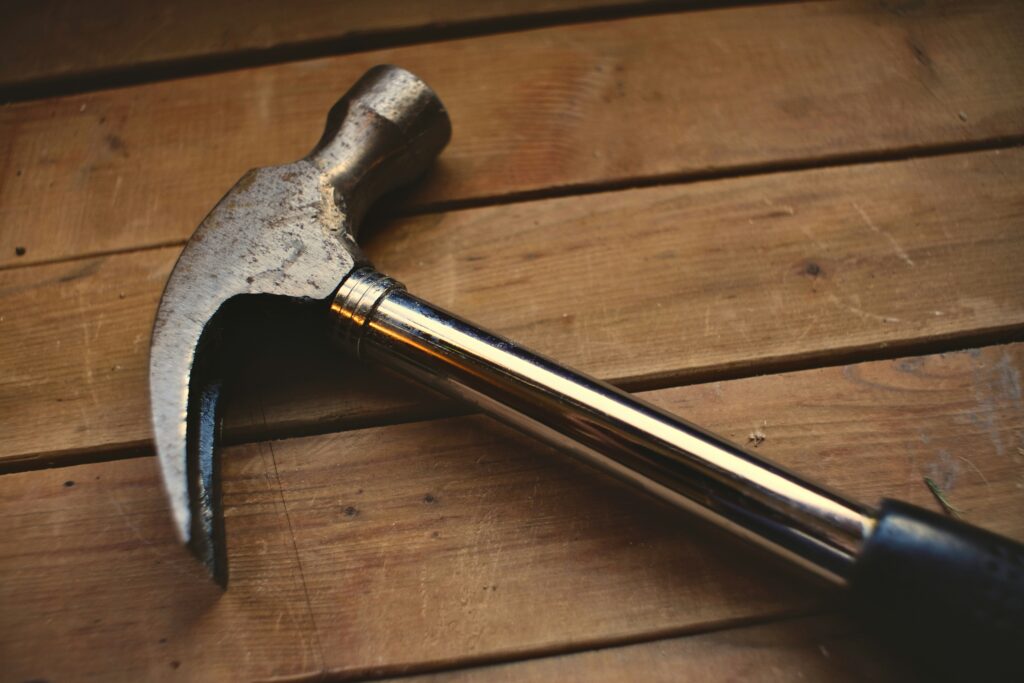
There are dozens of different types of hammers — each designed for a specific material, trade, or task. A framing hammer is not interchangeable with a finishing hammer; a ball peen hammer is not the same as a body hammer; a slide hammer is nothing like any of them. This guide covers every major hammer type: what it looks like, what it does, who uses it, and how to choose the right one.
Hammer Anatomy: Parts of a Hammer
Before the types, the terminology. Every hammer shares the same basic structure:
| Part | Description |
| Face / Poll | The flat striking surface — the part that hits the nail or workpiece |
| Peen | The opposite end of the head from the face; varies by hammer type (ball, cross, straight) |
| Cheek | The side of the head between face and peen |
| Eye | The hole in the head where the handle inserts |
| Handle / Haft / Helve | The grip portion; materials: wood (hickory), fiberglass, or steel with rubber grip |
| Neck | The narrowed section between the head and the handle eye |
Carpentry and Construction Hammers
Framing Hammer
The standard tool of rough carpentry and wall framing. A framing hammer is heavier than a typical household hammer (20-32 oz versus the standard 16 oz claw hammer), with a straight rip claw — a claw that is nearly straight rather than curved, designed for prying apart framing lumber with maximum leverage. The face is typically milled or waffled — a crosshatched or checkered pattern that grips nail heads and prevents glancing blows. The longer handle provides more power per swing.
Best brands: Estwing (steel, forged in one piece), Dalluge (milled face, excellent balance, made in USA — popular with professional carpenters), Stiletto (titanium head — dramatically lighter than steel for the same striking power, reducing fatigue). The Dalluge and Estwing framing hammers have loyal followings among professional framers for their durability and balance.
Finishing Hammer
A finishing hammer is lighter (7-10 oz) than a framing hammer and has a smooth face rather than a milled one. The smooth face prevents leaving marks or dents in finished wood surfaces when driving finish nails and setting nails below the surface with a nail set. Used for trim work, molding installation, furniture assembly, and any situation where the wood surface must not be marred.
Roofing Hammer
Also called a roofing hatchet, the roofing hammer has a flat striking face on one side and a hatchet-style blade on the other. A gauge notch or adjustable gauge on the blade side measures consistent shingle exposure — the amount of shingle visible below the overlapping course above. Some models include a magnetic nail holder to start nails one-handed. Weight is typically 12-16 oz. Purpose-built for hand-nailing shingles, though most professional roofers now use pneumatic nail guns.
Drywall Hammer
Also called a drywall hatchet, the drywall hammer has a convex (slightly domed) milled face designed to drive a drywall nail and leave a slight dimple in the paper facing without breaking through it — the dimple is then filled with joint compound to conceal the nail. The opposite end has a small blade for scoring and snapping drywall panels. Largely replaced by drywall screws and screw guns in modern construction, but still used for repairs and framing tasks.
Masonry and Demolition Hammers
Brick Hammer / Masonry Hammer / Mason Hammer
These names all refer to the same tool — a hammer with a square flat striking face and a chisel blade on the opposite end. Used for splitting brick, breaking off corners of stone blocks, scoring and splitting concrete block, and rough masonry work. Weight ranges from 18 to 32 oz. The chisel end is not sharp enough for fine stonework but is excellent for rough splitting and shaping. Essential tool for bricklayers, stonemasons, and any DIY work involving masonry.
Drilling Hammer (Club Hammer / Hand Drilling Hammer)
A short-handled hammer with a heavy head, typically weighing 2 to 4 pounds. Used with cold chisels, star drills, and punches for masonry work, concrete chipping, and driving stakes. The short handle provides controlled, powerful blows without the commitment of a full sledgehammer. Also called a club hammer in British usage. The ‘mini sledgehammer’ sometimes refers to this category.
Sledgehammer
The heavy hitter of demolition — a long-handled hammer with a head weighing 6 to 20+ pounds. Used two-handed for breaking up concrete, driving fence posts and stakes, demolishing walls, and breaking apart large masonry. The 10-pound sledge is the most versatile all-purpose size for homeowners and contractors. A 20-pound sledge provides maximum demolition force for heavy concrete breaking. The long handle generates significant swing energy — proper technique (letting the head do the work, not muscling the swing) prevents fatigue and injury.
Chipping Hammer / Welding Chipping Hammer
The chipping hammer in a welding context is a compact tool included with most arc welders, used to chip slag (the hardened flux residue) off completed welds. It has two functional ends: a pointed pick for getting into tight areas of the weld, and a chisel end for flatter slag removal. Striking technique matters — hitting at an angle to the weld bead chips the slag cleanly.
In a masonry context, a chipping hammer refers to a heavier tool (or a pneumatic hammer) used to chip and remove old tile, stucco, concrete, or stone. The welding chipping hammer is one of the most-searched variants because it is frequently sought by beginning welders who find their welds covered in slag and do not know what tool to use.
Metalworking Hammers
Ball Peen Hammer (Ball Pein Hammer)
The standard metalworking hammer, found in every machine shop and used by mechanics, machinists, and metal workers. It has two distinct faces: the flat poll face for striking punches, chisels, and driving rivets; and the rounded ball peen face for peening — work-hardening metal by repeated striking to round over rivet heads, remove metal fatigue stress, and shape sheet metal.
‘Peen’ and ‘pein’ are both correct spellings — ‘peen’ is more common in American usage. ‘Ball ping’ is a misspelling found frequently in search queries but refers to the same tool. Available in weights from 4 oz (precision work) to 32+ oz (heavy forging). Also called a machinist hammer.
What is a ball peen hammer used for? Primarily: setting and spreading rivets, striking cold chisels and punches (the ball peen is harder than standard claw hammers and less likely to shatter under repeated strikes on hardened tools), removing dents from the inside of metal panels, and metalworking generally.
Cross Peen Hammer
A metalworking and blacksmithing hammer with a wedge-shaped peen oriented perpendicular to the handle (across the axis of the handle — hence ‘cross’ peen). When you strike metal with the cross peen, it spreads the metal along the length of the handle direction. Used in forging to spread metal, draw out stock, and work specific areas of a workpiece. A straight peen hammer has the wedge aligned with the handle, spreading metal across the handle width instead.
Blacksmith Hammer / Forge Hammer
A relatively heavy (2-4 lb) hammer used for forging metal on an anvil. Blacksmith hammers typically have a flat face and either a cross peen or straight peen. The flat face is used for the majority of forging; the peen for drawing out stock and specific shaping operations. Weight and balance are critical in blacksmithing — a hammer that is too heavy causes fatigue during long forging sessions; one that is too light requires more strikes per operation. Most blacksmiths end up with several hammer weights for different tasks.
Planishing Hammer
A metal-forming tool with a very smooth, slightly convex face used to smooth and finish sheet metal panels after rough shaping. Planishing removes the hammer marks left during initial forming, creating a smooth, consistent surface. It is used in panel beating, coach building, and metal sculpture. Pneumatic planishing hammers (air-powered with an anvil attachment) are used in professional bodyshops for high-volume work. The tool is used in conjunction with a dolly — a shaped anvil held behind the panel — that provides backing while the planishing hammer works the surface.
Brass Hammer (Non-Sparking Hammer)
A hammer with a head made from brass rather than steel. Brass is softer than steel, which makes it useful in two specific situations: where marring or damaging the workpiece must be avoided (bearing installation, driving hardened pins into precision bores), and where sparking could be dangerous (around flammable gases, in explosive environments). Brass hammers are standard in automotive work for installing bearings, in explosives handling facilities, and in oil refineries. They are also available with copper, plastic, or rawhide heads for similar non-marring applications.
Sheet Metal Hammer
A general term for lighter hammers used in sheet metal fabrication — these may be planishing hammers, body hammers, or specific forming heads. Sheet metal work requires hammers that shape thin metal without cracking or tearing it, so the faces are always smooth and the weights are lower than structural hammers.
Automotive and Bodywork Hammers
Body Hammer
An automotive body repair tool used with a dolly to work out dents and reshape vehicle body panels. Body hammers come in multiple head shapes — flat face (for large flat areas), shrinking hammer (serrated face for stretching tight metal), and picking hammer (pointed pick for working out dents from the back of a panel). Body hammers are used in conjunction with metal dollies — shaped blocks held behind the panel to provide backing and shape while the hammer works the outside surface.
Slide Hammer (Dent Puller)
A specialized automotive tool consisting of a metal shaft with a heavy sliding weight and various attachment points. The weight slides along the shaft and impacts a stop at one end, transferring pulling force to whatever the other end is attached to. Uses include pulling dents in body panels (with a dent puller attachment that screws into a hole drilled in the dent), extracting stuck brake calipers, removing bearings and bushings, and pulling axles.
The slide hammer is also widely used in plumbing and HVAC work for extracting stuck components. It is one of the few tools that creates a pulling force rather than a pushing force — which is why it has no traditional equivalent. Slide hammer kits typically include multiple attachments for different pulling applications.
Specialty and Trade Hammers
Geologist Rock Hammer (Estwing Rock Hammer)
The standard field tool for geologists, paleontologists, and mineralogists — a compact hammer with a flat striking face and either a pointed pick end (for splitting rock along grain lines) or a chisel end (for general rock breaking). Estwing Manufacturing, based in Rockford, Illinois, has made the dominant American rock hammer since 1923. The Estwing E3-22P (pointed) and E3-22PC (chisel) are the most widely used models in geology programs and professional field work. The one-piece forged steel construction makes it essentially indestructible under field conditions.
Piano Tuning Hammer
More accurately called a tuning lever or tuning wrench, the piano tuning hammer is a T-shaped tool used by piano technicians to turn tuning pins — the threaded metal pins that hold the piano wire at pitch. Despite the name, it is not used for striking; it applies rotational force. The star-tipped socket end fits over the square tuning pin; the long lever handle provides the mechanical advantage needed to move tightly seated pins without slipping. Standard tip size is #2 for most pianos; various tip sizes exist for different vintage instruments.
Air Hammer (Pneumatic Hammer)
An air hammer (also called an air chisel) is a pneumatic tool powered by compressed air, used with interchangeable bits to perform cutting, shaping, and driving operations. It is not a traditional hammer — it generates rapid reciprocating motion from compressed air rather than human swing. Common air hammer bits include: panel cutter bits (for cutting sheet metal), chisel bits (for cutting rust, breaking loose bolts), hammer bits (for driving), and punch bits (for punching holes).
Air hammer bits are sized by the shank diameter (typically 0.401-inch for standard air hammers). The bits are consumable — they wear and can be replaced. Air hammers are standard in automotive shops for exhaust system work, rusted bolt removal, and body panel work.
Buying Guides and Notes
Dalluge Hammer
Dalluge (the full name is Dallüge) is an American hammer manufacturer known among professional carpenters for producing high-quality milled-face framing hammers. The Dalluge framing hammers are characterized by excellent balance, durable milled faces that last through extended professional use, and handles available in wood, fiberglass, or steel variants. They are made in the USA and are a step up in quality from standard contractor-grade framing hammers. The brand is relatively unknown to casual DIYers but has a dedicated following among finish and frame carpenters.
Estwing Framing Hammer
Estwing makes the most recognized American-made hammers — forged in one piece from steel (head and handle in a single solid forging), with a leather or shock-reduction vinyl grip. The Estwing framing hammer (E3-22S or E3-22SM for milled face) is a professional tool known for durability and the one-piece construction that eliminates the head-flying-off failure mode of wood-handled hammers. Estwing tools are made in Rockford, Illinois.
Left-Handed Hammer
There is no structural difference between a left-handed and a right-handed hammer — any hammer works equally well in either hand. Left-handed users sometimes prefer hammers with straight handles (rather than curved pistol-grip handles) for more natural swing mechanics. This is a common search from left-handed people who are not aware that all hammers are ambidextrous.
Custom Hammer
Custom hammers are handmade or small-batch tools made by artisan hammer makers — popular in the blacksmithing, woodworking, and traditional trades communities. They typically feature drop-forged or hand-forged heads and handles made from exotic or traditional wood species (ash, hickory, osage orange). Custom hammers from recognized makers can cost $50-300 or more depending on the craft involved. They are working tools, not merely decorative.
Quick Reference: All Hammer Types at a Glance
| Hammer | Primary Use | Key Feature |
| Framing hammer | Rough carpentry, framing | Heavy (20-32 oz), milled face, straight rip claw |
| Finishing hammer | Trim, molding, finish carpentry | Light (7-10 oz), smooth face |
| Roofing hammer | Shingle installation | Hatchet blade + gauge notch |
| Drywall hammer | Installing drywall | Convex milled face + scoring blade |
| Brick/Masonry hammer | Splitting and shaping masonry | Square face + chisel end |
| Drilling/Club hammer | With chisels, masonry work | Short handle, heavy head (2-4 lb) |
| Sledgehammer | Demolition, post driving | Long handle, 6-20+ lb head |
| Ball peen hammer | Metalworking, rivets, punches | Ball face + flat face |
| Cross peen hammer | Forging, spreading metal | Wedge peen perpendicular to handle |
| Blacksmith/Forge hammer | Forging metal on anvil | Heavy (2-4 lb), cross or straight peen |
| Planishing hammer | Smoothing sheet metal | Very smooth convex face |
| Body hammer | Automotive dent repair | Smooth face, used with dolly |
| Slide hammer | Pulling dents, extracting parts | Sliding weight on shaft |
| Chipping hammer | Removing weld slag | Pick end + chisel end |
| Brass hammer | Non-sparking, non-marring | Brass head (softer than steel) |
| Geologist rock hammer | Field geology, rock splitting | Pick or chisel end (Estwing) |
| Air hammer/chisel | Pneumatic cutting and driving | Compressed air, interchangeable bits |
| Piano tuning hammer | Turning piano tuning pins | T-shaped lever/wrench |
Frequently Asked Questions
What is a ball peen hammer used for?
A ball peen hammer (also spelled ball pein) is a metalworking tool used to peen (work-harden and round) rivets, strike cold chisels and punches, shape sheet metal, and perform general metalworking. The flat face is for driving; the rounded ball peen face is for spreading and rounding metal. It is the standard hammer in machine shops and automotive workshops.
What is a roofing hammer?
A roofing hammer — also called a roofing hatchet — has a flat striking face and a hatchet blade on the opposite end, with a gauge notch for measuring consistent shingle exposure. It is used for hand-nailing roofing shingles, though pneumatic nail guns have largely replaced it in professional roofing.
What is a chipping hammer?
A chipping hammer removes slag from arc welds. It has a pointed pick end (for tight weld areas) and a flat chisel end (for flat weld surfaces). It is included with most arc welders and is an essential tool for any welder. In masonry, the term also refers to heavier tools for chipping concrete, tile, and stucco.
What is a slide hammer?
A slide hammer uses a heavy weight that slides along a shaft to create a pulling force when the weight impacts a stop. It is used for pulling vehicle body dents (with a dent attachment), extracting stuck components like brake calipers and bearings, and removing axles. It is the only common tool that creates pulling rather than pushing force.
What is a planishing hammer?
A planishing hammer smooths and finishes sheet metal panels after rough forming. It has a very smooth, slightly convex face and is used with a dolly backing tool to create a smooth, mark-free metal surface. Standard in automotive body repair, coach building, and metal art.
What are hammer parts called?
The main parts of a hammer are: the head (which includes the face/poll, the cheek, the eye, and the peen); and the handle (also called the haft or helve). The face is the striking surface; the peen is the opposite end of the head; the eye is the hole through which the handle passes.
Final Thoughts
The right hammer for the job is not always obvious — a framing hammer used for finish work will dent the wood; a finishing hammer used for framing will be exhausting and slow. The fundamentals are straightforward: match the weight and face style to the material (milled face for rough work, smooth face for finished surfaces), match the head type to the task (claw for carpentry, peen for metalwork, chisel end for masonry), and match the handle length to the power needed. Most homeowners need two or three hammers at most — a framing/general hammer, a ball peen for metalwork, and a drilling/club hammer for masonry. Professional tradespeople add specialty hammers as their work demands. Every one of the types in this guide exists because someone needed a tool to do a specific job better than the available options could — and that specificity is exactly why they all have names.