
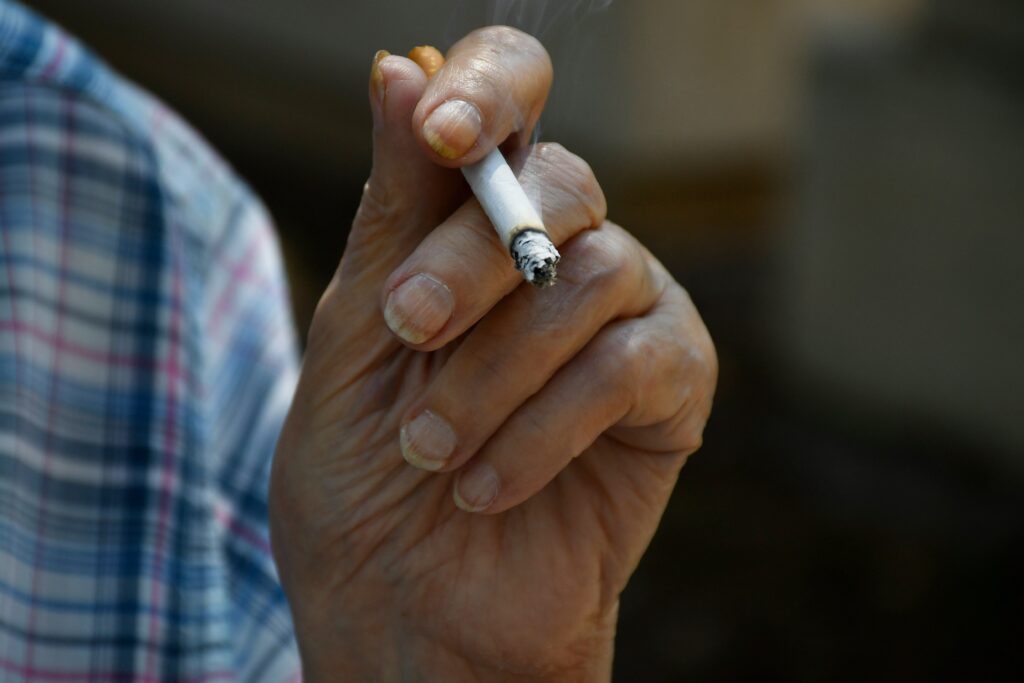
Cigarette smoke is one of the most challenging indoor air quality problems an air purifier can face. Unlike dust or pollen — simple particles that any decent HEPA filter handles — cigarette smoke is a two-part problem: fine particles (ash, soot, tar) that HEPA captures, and gaseous compounds (volatile organic compounds, or VOCs) that produce the persistent odor and represent the most toxic portion of secondhand smoke. An air purifier that handles only one of these two components is half a solution.
This guide covers the best air purifier for cigarette smoke in 2026, with honest assessments of what works, what doesn’t, and why the weight of the activated carbon layer matters more than almost any other specification.
Why Cigarette Smoke Requires Specific Air Purifier Technology
Cigarette smoke contains over 7,000 chemicals, hundreds of which are toxic and approximately 70 of which are known carcinogens. The smoke you can see — the particles — is actually the easier part to address. The harder problem is the invisible chemical components:
- Fine particles (0.1-1 micron): The ash, soot, and tar particles in smoke. True HEPA filters capture 99.97% of particles at 0.3 microns, handling this portion effectively.
- VOCs (volatile organic compounds): The chemical gases responsible for the lingering odor — benzene, formaldehyde, acrolein, and dozens of others. HEPA filters are physically incapable of capturing gases; only activated carbon adsorption addresses VOCs.
- Third-hand smoke: VOCs and particles that settle into fabrics, carpets, walls, and furniture continue to off-gas for hours or days. An air purifier addresses airborne components but cannot reverse third-hand smoke that has already embedded in surfaces.
The practical implication: any air purifier for cigarette smoke must have both True HEPA filtration (for particles) and a substantial activated carbon layer (for VOCs and odor). A purifier with only one of these components provides inadequate smoke protection.
Best Air Purifiers for Cigarette Smoke 2026: Quick Comparison
| Model | Price | Coverage | Carbon | CADR | Best For |
| Austin Air HM400 | ~$715 | 1,500 sq ft | 15 lbs | ~400 | Heavy smokers; large rooms; best overall |
| RabbitAir MinusA2 | ~$550 | 815 sq ft | ~2 lbs | ~245 | Moderate smoke; smart features; quiet |
| IQAir GC MultiGas | ~$1,099 | 1,125 sq ft | 12 lbs | ~300 | Chemical-sensitive; maximum VOC removal |
| Levoit Core 600S | ~$299 | 635 sq ft | ~1 lb | ~410 | Moderate smoke; value pick; smart home |
| Blueair 211+ Auto | ~$329 | 540 sq ft | ~0.5 lb | ~350 | Light smoke; quiet; large rooms on budget |
| Winix 5500-2 | ~$160 | 360 sq ft | ~0.5 lb | ~243 | Budget; light smoke; small rooms |
| Coway Airmega 400 | ~$329 | 1,560 sq ft | ~1 lb | ~350 | Large room; dual HEPA; moderate smoke |
The Two Non-Negotiable Features for Smoke
1. True HEPA Filter
True HEPA (not ‘HEPA-type’ or ‘HEPA-style’) captures 99.97% of airborne particles at 0.3 microns. Since smoke particles range from 0.1-1 micron, True HEPA captures the great majority of them. Look for this certification explicitly in the product specifications — not in marketing descriptions.
H13 HEPA (the hospital-grade standard) provides marginally better capture at 99.95% efficiency and is found in higher-end models like the Levoit Core 600S and RabbitAir MinusA2. For heavy smoke environments, H13 is worth the premium.
2. Activated Carbon — More Is Better for Smoke
Activated carbon adsorbs VOCs at a molecular level — the porous carbon surface traps gaseous compounds. For cigarette smoke, which is particularly VOC-heavy, the weight of the carbon layer is the most important indicator of long-term effectiveness:
- Under 1 lb of carbon: Handles light smoke or general household odors; saturates quickly under regular smoke exposure
- 1-3 lbs of carbon: Adequate for moderate smoking in medium-sized rooms; replace every 3-6 months
- 5-15 lbs of carbon: Appropriate for heavy smoking, large rooms, or situations where continuous smoke exposure is expected
Many budget air purifiers use thin carbon-impregnated filters that provide minimal VOC absorption. These saturate within weeks under smoke exposure and may release previously captured compounds back into the air. When the carbon is saturated, the ‘odor filter’ stops working entirely while the HEPA filter continues — leaving the gaseous portion of cigarette smoke unaddressed.
Best Air Purifiers for Cigarette Smoke: Detailed Reviews
1. Austin Air HealthMate HM400 — Best Overall for Cigarette Smoke
The Austin Air HealthMate HM400 is the definitive recommendation for households with regular cigarette smoke. Its 15 lbs of activated carbon — combined with True HEPA filtration — provides the most complete cigarette smoke treatment available at a reasonable price. The carbon capacity means the filter won’t saturate for years rather than months, making the total cost of ownership competitive despite the $715 upfront price.
Austin Air has manufactured air purifiers in Buffalo, NY since 1990. The HealthMate’s cylindrical 360-degree intake design pulls air in from all sides, maximizing effectiveness in open spaces. The 5-year filter lifespan dramatically reduces ongoing costs — at approximately $0.39/day over 5 years including purchase price, it’s genuinely cost-effective for heavy smoke applications.
- Filter: True HEPA + 15 lbs activated carbon
- CADR: ~400 | Coverage: 1,500 sq ft
- Filter life: 5 years (longest available for smoke applications)
- Carbon weight: 15 lbs — best for VOC and odor capacity
- Price: ~$715
- Best for: Daily smokers; large rooms; serious odor control; long-term value
- Verdict: Best overall air purifier for cigarette smoke — unmatched carbon capacity
2. RabbitAir MinusA2 — Best Smart Air Purifier for Smoke
The RabbitAir MinusA2 is the best air purifier for cigarette smoke if smart features and quiet operation are priorities alongside filtration performance. Its six-stage filtration system includes a pre-filter, medium filter, BioGS HEPA, customizable filter panel (the ‘Odor Remover’ configuration is optimal for smoke), activated carbon, and negative ionizer — a more complete filtration stack than most competitors.
The MinusA2 is wall-mountable, runs at 25.6 dB on its lowest setting (the quietest smoke air purifier on this list), and includes WiFi and app control. For moderate smokers in living rooms or bedrooms who want smart home integration alongside effective smoke filtration, it’s the best combination.
- Filter: True HEPA + activated carbon + six-stage system
- CADR: ~245 | Coverage: 815 sq ft
- Noise: 25.6-51.3 dB (quietest on this list)
- Carbon: ~2 lbs
- Smart features: WiFi, app control, auto mode, air quality sensor
- Price: ~$550
- Best for: Moderate smokers; smart home users; quiet bedrooms/living rooms
3. IQAir GC MultiGas — Best for Chemical Sensitivity and Maximum VOC Removal
The IQAir GC MultiGas is the most powerful air purifier for VOC and chemical removal from cigarette smoke — designed specifically for gas-phase pollutants rather than particles. It contains approximately 12 lbs of granular activated carbon and alumina impregnated with potassium permanganate, which provides oxidative destruction of VOCs in addition to adsorption. For individuals with chemical sensitivities or in enclosed spaces with heavy smoke, it’s in a different class.
The GC MultiGas pairs well with the IQAir HealthPro Plus (particle-focused) for maximum comprehensive smoke treatment, though the combined cost exceeds $2,000. As a standalone unit, it handles both particles (via pre-filter) and gases (via its specialized media) effectively.
- Filter: Granular activated carbon + alumina/KMnO4 blend
- Carbon: ~12 lbs of specialized gas-phase media
- Price: ~$1,099
- Best for: Chemical sensitivity; maximum VOC removal; enclosed smoking areas
4. Levoit Core 600S — Best Value Air Purifier for Smoke
The Levoit Core 600S is the best value pick for moderate cigarette smoke — its H13 HEPA filter and 410 CADR handle particle removal exceptionally well, and the activated carbon layer (approximately 1 lb) addresses light to moderate VOC loads. For occasional smokers or secondhand smoke from neighbors, the Core 600S provides very good protection at $299.
The VeSync app provides real-time PM2.5 monitoring, auto mode that adjusts fan speed based on air quality, and scheduling. The 410 CADR — higher than the Austin Air HM400 on paper — means faster air processing, though the carbon weight is a fraction of the Austin Air’s capacity.
- Filter: True HEPA H13 + activated carbon (~1 lb)
- CADR: 410 | Coverage: 635 sq ft
- Smart: VeSync app, auto mode, real-time PM2.5
- Price: ~$299
- Best for: Occasional smokers; secondhand smoke; value-focused buyers
- Limitation: Carbon saturates faster than premium options under heavy smoke
5. Blueair Blue Pure 211+ Auto — Best Budget Large-Room Pick
The Blueair Blue Pure 211+ Auto covers up to 540 square feet and operates exceptionally quietly. Its HEPASilent technology combines mechanical and electrostatic filtration for efficient particle capture with lower noise and energy consumption than standard HEPA motors. The auto mode uses an integrated particle sensor to adjust fan speed automatically.
The carbon filter in the 211+ is relatively thin and better suited for light smoke and general household odors than heavy cigarette smoke. For renters dealing with occasional secondhand smoke from neighbors, or light indoor smoking, it’s an effective and budget-friendly solution.
- Filter: HEPASilent + activated carbon
- CADR: ~350 | Coverage: 540 sq ft
- Noise: Exceptionally quiet
- Auto mode: Particle sensor + automatic fan adjustment
- Price: ~$329
- Best for: Light smoke; secondhand smoke from neighbors; quiet operation priority
6. Winix 5500-2 — Best Budget Pick for Small Rooms
The Winix 5500-2 is the best affordable air purifier for cigarette smoke in small rooms. At $160, True HEPA + PlasmaWave (which neutralizes VOCs and odors at a molecular level) + activated carbon provides a surprisingly complete three-layer approach to smoke. PlasmaWave is particularly relevant for smoke because it attacks the gaseous VOC components that the limited carbon layer can’t fully handle on its own.
- Filter: True HEPA + PlasmaWave + activated carbon
- CADR: ~243 | Coverage: 360 sq ft
- PlasmaWave: Neutralizes VOCs between filter replacements
- Price: ~$160
- Best for: Budget buyers; small rooms; light to moderate smoke
7. Coway Airmega 400 — Best for Large Open-Plan Spaces
The Coway Airmega 400 covers up to 1,560 square feet with dual True HEPA filters and a bipolar ionization system. Its CADR of approximately 350 combined with dual-filter configuration makes it effective for large living rooms, open-plan areas, or whole-level coverage in a mid-size home. The carbon capacity is moderate (~1 lb total), making it better suited for moderate smoke environments than heavy ones.
- Filter: Dual True HEPA + activated carbon + ionizer
- CADR: ~350 | Coverage: 1,560 sq ft
- Price: ~$329
- Best for: Large rooms; open-plan living areas; moderate smoke
How to Choose the Right Air Purifier for Your Smoke Situation
| Your Situation | Recommended Pick |
| Daily indoor smoker; large room | Austin Air HM400 (~$715) — 15 lbs carbon essential |
| Daily indoor smoker; medium room | Austin Air HM400 or RabbitAir MinusA2 |
| Occasional/light smoker; medium room | Levoit Core 600S (~$299) — good balance |
| Secondhand smoke from neighbors | Levoit Core 600S or Winix 5500-2 |
| Very large open-plan space | Austin Air HM400 or Coway Airmega 400 |
| Chemical sensitivity; VOC priority | IQAir GC MultiGas (~$1,099) |
| Tight budget; small bedroom | Winix 5500-2 (~$160) |
| Quiet operation priority | RabbitAir MinusA2 (25.6 dB lowest setting) |
CADR for Smoke: How to Calculate What You Need
The Clean Air Delivery Rate Smoke (CADR Smoke) measures how many cubic feet of smoke-free air the purifier delivers per minute. The formula for sizing:
- Minimum: CADR Smoke ≥ (room square footage × 0.67)
- Recommended for smoke: CADR Smoke ≥ (room square footage × 0.9) — oversize by 30-35% for smoke vs standard air quality
- Example: 400 sq ft room needs at minimum 268 CADR Smoke; recommended 360+ for cigarette smoke
For heavy smokers: aim for 4-5 air changes per hour (ACH) rather than the standard 2. This means running a higher-CADR purifier or placing multiple units in the space.
Placement and Usage Tips for Maximum Smoke Removal
- Place near the smoking area — capturing smoke at the source before it disperses is significantly more effective than placing the purifier across the room
- Run continuously — cigarette smoke lingers in air and off-gasses from furniture and fabrics for hours after smoking stops; continuous operation is essential
- Give the purifier breathing room — at least 2-3 feet from walls and corners for optimal air intake
- Boost ventilation — brief window opening after smoking reduces the VOC load the purifier must handle, extending carbon filter life
- Monitor filter saturation — with smoke, carbon filters saturate faster than the manufacturer’s stated timeline; if odor returns while the purifier is running, the carbon is likely saturated
Reducing Third-Hand Smoke Alongside Your Purifier
An air purifier addresses airborne smoke but cannot remove third-hand smoke already embedded in surfaces. Combine with:
- Wash curtains, blankets, and fabric covers regularly — fabrics absorb and release smoke VOCs continuously
- Steam-clean carpets and upholstered furniture — hot steam releases embedded compounds that the air purifier can then capture
- Wipe walls and hard surfaces with a white vinegar solution — removes tar residue
- Repaint walls with odor-sealing primer if smoke odor is severe — creates a barrier preventing further off-gassing
- Open windows briefly after smoking when outdoor conditions allow — dilutes indoor VOC concentration
Frequently Asked Questions
What is the best air purifier for cigarette smoke?
The Austin Air HealthMate HM400 (~$715) is the best overall air purifier for cigarette smoke due to its 15 lbs of activated carbon — by far the most of any consumer air purifier. This carbon capacity handles both the immediate odor and the long-term VOC load from regular smoking without rapid saturation. For moderate smokers or those on a budget, the Levoit Core 600S (~$299) provides good protection for rooms up to 635 sq ft with H13 HEPA and smart monitoring.
Do air purifiers actually remove cigarette smoke?
Yes, with the right technology. Air purifiers with True HEPA filters capture smoke particles (ash, soot, tar) effectively. Activated carbon layers remove VOCs and odor. Together, these two filtration methods significantly reduce both the visible and invisible components of cigarette smoke. Studies show continuous HEPA + carbon filtration can reduce indoor smoke particle concentrations by 80-90%+ within a few hours. However, air purifiers work on airborne smoke only — they cannot remove smoke that has already settled into surfaces, fabrics, and walls.
Do air purifiers remove secondhand smoke?
Yes — air purifiers with True HEPA and activated carbon reduce secondhand smoke concentrations substantially. For protection from a neighbor’s cigarette smoke coming through shared ventilation or gaps, run the purifier continuously at medium-high speed. Place it near the air entry point (vent, gap under door) when possible to capture smoke before it disperses through the room.
Is HEPA alone enough for cigarette smoke?
No. HEPA filters handle the particle portion of cigarette smoke (what you can see) but are physically incapable of capturing VOCs (what causes the smell and most of the chemical toxicity). Without activated carbon, the gaseous components of cigarette smoke pass straight through a HEPA filter. Any effective cigarette smoke air purifier must have both True HEPA and activated carbon — the carbon weight determines how long the odor protection lasts.
How often should I replace the filters in a smoke air purifier?
For regular smokers, plan to replace filters more frequently than manufacturer timelines suggest — those timelines are calculated for average household air, not smoke-heavy environments. Carbon filters: every 3-6 months for daily smokers (vs 12 months in smoke-free homes). HEPA filters: every 6-12 months for daily smokers (vs 12-18 months in smoke-free homes). The Austin Air HM400’s 5-year filter lifespan is exceptional — its 15 lbs of carbon takes significantly longer to saturate than competitors. If odor returns while the purifier is running, the carbon filter is saturated and needs replacement.
Final Thoughts
The best air purifier for cigarette smoke is one that takes both parts of the problem seriously — fine particles and VOCs. For daily smokers or anyone dealing with heavy smoke exposure, the Austin Air HealthMate HM400’s 15 lbs of activated carbon is the most effective solution available without spending more than $1,000. For moderate smokers or secondhand smoke situations, the Levoit Core 600S provides a compelling balance of H13 HEPA performance, 635 sq ft coverage, and smart features at $299.
Run your purifier continuously, replace carbon filters on schedule (or ahead of schedule for heavy use), and combine with surface cleaning to address third-hand smoke. Together, these steps create a genuinely cleaner indoor environment.