
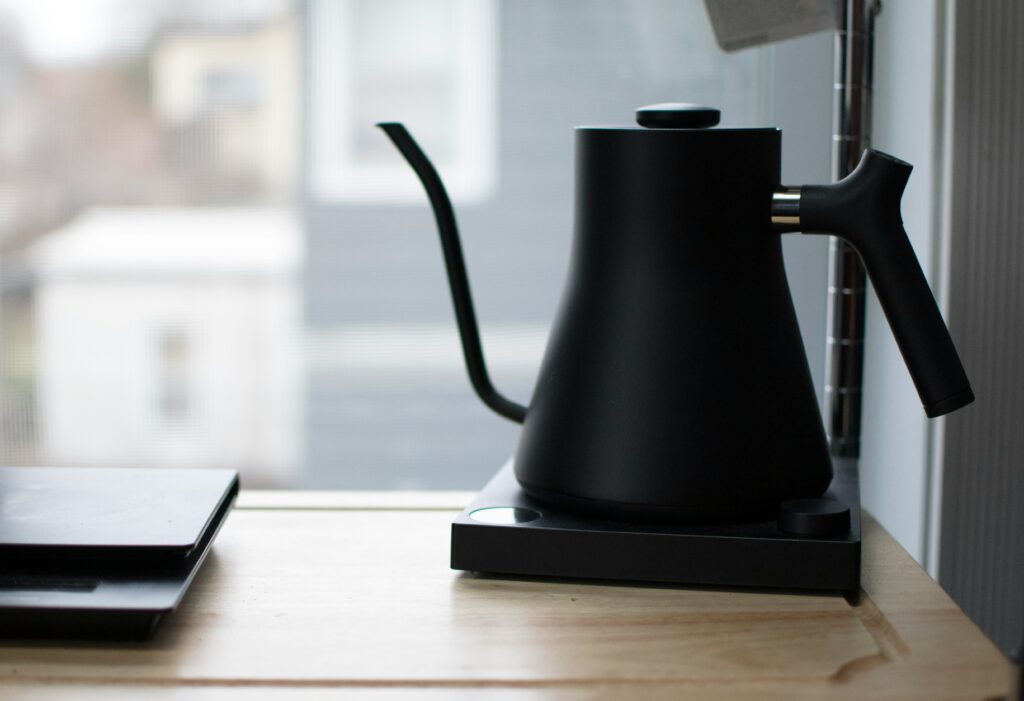
A gooseneck kettle is the single most impactful equipment upgrade for pour over coffee brewing — more so than a premium dripper, more so than an expensive scale. The narrow, curved spout gives you precise control over where and how fast you pour water, which directly determines how evenly your coffee grounds are saturated and how consistently your pour over extracts. Try brewing a V60 with a standard wide-mouth kettle and then with a gooseneck, and the difference in cup quality is immediately apparent.
This guide covers the best gooseneck kettles available in 2025 — electric and stovetop, budget and premium — with the specifications and practical details that matter for daily coffee brewing.
Best Gooseneck Kettles: Quick Reference
| Kettle | Type | Price | Capacity | Best For |
| Fellow Stagg EKG | Electric | ~$165 | 0.9L | Best overall; temperature hold |
| Hario Buono V60 Kettle | Stovetop | ~$45–55 | 0.8L / 1.2L | Best stovetop; budget start |
| Brewista Artisan | Electric | ~$80–90 | 600ml / 1L | Best mid-range electric |
| Bonavita Variable Temp | Electric | ~$40–55 | 1L | Best budget electric |
| Takahiro Shizuku | Stovetop | ~$130–170 | 0.5L / 0.9L | Best premium stovetop |
| Fellow Stagg EKG Pro | Electric | ~$200 | 0.9L / 1.2L | Best for multi-user; Bluetooth |
| Timemore Fish Smart | Electric | ~$55–70 | 800ml | Best value electric with temp |
Best Gooseneck Kettles: Detailed Reviews
1. Fellow Stagg EKG — Best Overall Gooseneck Kettle
Type: Electric | Price: ~$165 | Capacity: 0.9L | Temperature Range: 135–212°F | Hold Time: Up to 60 minutes
The Fellow Stagg EKG is the most widely recommended electric gooseneck kettle in the specialty coffee community and the standard against which other electric pour over kettles are measured. Fellow designed the EKG specifically for pour over coffee brewing, and every aspect of its design reflects that purpose: a slow, precise, controllable flow rate from the narrow curved spout; a counterbalanced handle that makes sustained pouring comfortable; an LCD display showing real-time temperature; and a variable temperature hold function that maintains your target temperature for up to 60 minutes.
The temperature precision is the EKG’s defining feature — you can set the temperature in 1-degree increments between 135°F and 212°F. For pour over coffee, the ideal range is 195°F to 205°F, and the EKG holds your target within a degree throughout the entire brewing session. This consistency makes a noticeable difference in extraction quality compared to kettles that heat to boiling and then cool down during the pour.
The flow rate is deliberately slow and steady — one of the slowest and most controllable among electric kettles. This characteristic makes it particularly well-suited to cone brewers (V60, Chemex) where flow control determines extraction. For flat-bottomed brewers (Kalita Wave) where flow is less critical, the slower rate is less important but not a disadvantage. Fellow has become a design icon in specialty coffee equipment, and the EKG’s aesthetic — matte black or polished steel finish, minimal LCD, clean lines — reflects that reputation.
- Best for: Daily pour over brewing; V60 and Chemex users; anyone who wants precise temperature control
- Key advantage: Temperature hold for 60 minutes; 1-degree precision; slow controlled flow
- Limitation: ~$165 price; 0.9L capacity requires refilling for multiple cups
2. Hario Buono — Best Stovetop Gooseneck Kettle
Type: Stovetop | Price: ~$45–55 | Capacity: 0.8L or 1.2L | Material: Stainless steel
The Hario Buono is the original pour over kettle that set the standard for the category — created by the same Japanese company that made the V60 dripper, the Buono was designed specifically to complement pour over brewing with a spout geometry that produces a smooth, well-controlled water flow. It has been the default kettle in specialty coffee shops worldwide for over a decade and remains one of the most reliable and well-designed stovetop options available.
The Buono’s flow rate is faster than the Fellow Stagg EKG — not imprecise, but less restricted. For most home brewers this is fine; for beginners still learning to control their pour, the slightly faster flow means a bit less margin for error compared to the EKG. The main practical advantage over electric alternatives is price ($45 to $55 vs $165 for the EKG) and simplicity — no display to worry about, no battery or heating element to potentially fail, just a well-made stainless steel kettle that works on any stovetop.
The Buono is available in two sizes: 0.8L (suitable for 1 to 2 cups) and 1.2L (suitable for 2 to 3 cups). For home use with a separate thermometer (a $10 kitchen thermometer works fine), the Buono is the recommended starting point for anyone who doesn’t want to spend $165 on a kettle before they know how committed they are to pour over brewing.
- Best for: Budget-conscious pour over brewers; stovetop preference; beginners testing pour over
- Key advantage: Best value stovetop option; proven design; works on all stovetops including induction
- Limitation: No built-in temperature control — use a separate thermometer; faster flow rate than EKG
3. Brewista Artisan — Best Mid-Range Electric Gooseneck Kettle
Type: Electric | Price: ~$80–90 | Capacity: 600ml or 1L | Temperature Range: 104–212°F
The Brewista Artisan is the best mid-range electric gooseneck kettle — a well-designed electric pour over kettle that provides variable temperature control and a precision spout at a price point between the budget Bonavita and premium Fellow EKG. The Artisan’s spout is notably narrow and long, producing one of the most precise and controllable pours available among electric goosenecks. The temperature dial is straightforward and the hold function maintains temperature during brewing.
For pour over brewers who want temperature control and a precision spout without paying the Fellow premium, the Artisan is the most compelling option. The 600ml version is ideal for single-cup brewing where precise flow control matters most; the 1L version handles larger batches. Build quality and materials are solid without being exceptional.
- Best for: Pour over enthusiasts who want temperature control under $100
- Key advantage: Very precise narrow spout; variable temperature; mid-range price
4. Bonavita Variable Temperature Kettle — Best Budget Electric Gooseneck Kettle
Type: Electric | Price: ~$40–55 | Capacity: 1L | Temperature Range: 140–212°F
The Bonavita Variable Temperature Kettle is the most recommended budget electric gooseneck kettle — a 1L electric kettle with variable temperature control (140°F to 212°F in preset increments) at a price point that makes electric temperature control accessible to beginners. The Bonavita’s spout produces a faster, less restricted flow than the Fellow EKG — more of a ‘fast and controlled’ pour versus the EKG’s ‘slow and precise’ pour.
The faster flow is a genuine practical difference: for V60 brewing where a slow, deliberate bloom and controlled main pour is the standard technique, the Bonavita requires more active flow control from the wrist to prevent pouring too fast. For flat-bottomed brewers (Kalita Wave, Chemex) where a slightly faster pour is acceptable, the Bonavita is a well-suited and affordable choice.
- Best for: Budget buyers wanting electric temperature control; Kalita Wave and Chemex users
- Key advantage: Affordable electric temperature control; 1L capacity
- Limitation: Faster flow rate requires more active wrist control vs Fellow EKG
5. Takahiro Shizuku — Best Premium Stovetop Gooseneck Kettle
Type: Stovetop | Price: ~$130–170 | Capacity: 0.5L or 0.9L | Material: Stainless steel
The Takahiro Shizuku is widely regarded as the finest stovetop pour over kettle available — a Japanese-made kettle with a uniquely small spout opening that produces the slowest, most precise water flow you can achieve from any kettle. Blue Bottle Coffee has described the original Takahiro as the ‘Rolls Royce of coffee kettles,’ and the Shizuku (which means ‘droplet’ in Japanese) takes that precision further with an even narrower spout than the standard Takahiro.
The Shizuku’s ultra-narrow spout means water exits in an almost thread-thin stream at low pour speeds — giving the brewer an extraordinary level of control over exactly where and at what rate water contacts the coffee bed. For cone brewer enthusiasts (V60, Chemex) who have mastered technique and want to optimize further, the Takahiro represents the pinnacle of stovetop control. It requires a separate thermometer for temperature measurement, and the small spout means slightly slower pouring for larger batches.
- Best for: Serious pour over enthusiasts; V60 specialists; those who appreciate Japanese craftsmanship
- Key advantage: Finest flow control available; legendary build quality; will last decades
- Limitation: $130–170 price; no temperature control built in; electric option unavailable
6. Fellow Stagg EKG Pro — Best for Multi-User Households
Type: Electric | Price: ~$200 | Capacity: 0.9L or 1.2L | Features: Bluetooth app control, higher precision
The Fellow Stagg EKG Pro is the upgraded version of the standard EKG — adding Bluetooth connectivity that allows temperature presets and profiles to be saved and controlled via the Fellow app. The practical benefit for most home users is limited (the standard EKG’s dial is already precise), but the Pro adds the ability to program named presets (e.g., ‘V60 light roast,’ ‘Chemex,’ ‘green tea’) and wake the kettle remotely so it’s ready when you are.
The EKG Pro makes most sense for households with multiple brewers or enthusiasts who routinely switch between different brewing methods requiring different temperatures. At $200, the Pro’s Bluetooth feature is primarily a convenience upgrade over the standard EKG at $165 rather than a quality upgrade.
7. Timemore Fish Smart — Best Value Electric Gooseneck with Temperature Control
Type: Electric | Price: ~$55–70 | Capacity: 800ml | Temperature Range: 104–212°F
The Timemore Fish Smart is a Chinese-made electric gooseneck kettle with variable temperature control at a price point that competes with the Bonavita. Timemore is best known for its manual coffee grinders (the Chestnut C2 is widely recommended) and has applied the same value-engineering approach to this kettle: solid build quality, precise temperature control, and good flow rate at a competitive price.
The Fish Smart’s flow is slightly more controlled than the Bonavita, making it a better choice for V60 brewing on a budget. The temperature display is clear and the heat-up time is reasonable. For buyers who want electric temperature control without paying Fellow or Brewista prices, the Timemore Fish Smart and Bonavita are the two best options — the Timemore edges ahead for V60 brewing, the Bonavita for larger volume brewing.
Electric vs Stovetop Gooseneck Kettle: How to Choose
| Factor | Electric Gooseneck Kettle | Stovetop Gooseneck Kettle |
| Temperature control | Precise — set exact temperature | Manual — use separate thermometer |
| Temperature hold | Yes — most hold for 60 minutes | No — cools after heating |
| Price | $40–200 depending on model | $45–170 depending on model |
| Counter space | Requires dedicated counter space | Stored with other cookware |
| Heat-up speed | Typically 3–5 minutes | Similar on gas; slower on electric stove |
| Best for | Daily pour over; precise temperature needs | Occasional brewing; minimalist setup |
For daily pour over brewing, an electric kettle with temperature control makes a meaningful difference. Heating water to precisely 200°F (rather than boiling and guessing when it cools enough) consistently produces better extraction — particularly with light roasts where temperature sensitivity is highest. For occasional brewers or those who prefer a simple setup, a stovetop kettle with a $10 separate thermometer is a practical and affordable alternative.
What Makes a Good Gooseneck Kettle: Key Specifications
Spout Design and Flow Rate
The spout is the most important design element in a gooseneck kettle — specifically, its length, curvature, and opening diameter. These three factors determine how controllable and precise the pour is. Longer, more curved spouts (like the Fellow Stagg EKG and Takahiro Shizuku) produce slower, more controllable pours. Shorter, wider spouts (like the Kalita Wave Kettle and Bonavita) produce faster, higher-volume pours.
For cone brewers (Hario V60, Chemex): slower, more precise flow is better — it gives you control over the bloom pour and allows a steady, circular main pour. For flat-bottomed brewers (Kalita Wave) or larger batches: a slightly faster, more confident flow is more practical.
Temperature Control
The ideal brewing temperature for pour over coffee is 195°F to 205°F (90°C to 96°C). Water below 190°F under-extracts coffee (producing sour, weak results); water above 205°F can over-extract and produce harsh, bitter notes. Electric kettles with variable temperature allow you to set exactly 200°F and hold it — stovetop kettles require a thermometer and careful timing. For light roast specialty coffee where temperature sensitivity is highest, precise temperature control is a meaningful quality factor.
Capacity
Standard gooseneck kettle capacities and what they suit:
- 500–600ml: Single cup; ideal for ultra-precise small-batch pour over; requires refilling for multiple cups
- 800ml–1L: 1–3 cups; most practical for daily home use
- 1.2L+: 2–4 cups; best for households or larger batch brewing
A general rule: choose the smallest capacity that reliably handles your typical batch size. Smaller kettles are lighter and easier to maneuver during pouring, which matters when you’re holding the kettle for 2 to 3 minutes of controlled brewing.
Handle Design
Handle weight distribution affects how comfortable the kettle is to hold during brewing. A weighted handle (heavier at the base) counterbalances the water weight at the spout end — making a full kettle easier to control than one with a light, hollow handle. The Fellow Stagg EKG’s handle is a well-cited example of good ergonomic weighting. When evaluating kettles in person, lift them while partially filled and mimic the pouring motion — the balance difference between well and poorly designed handles is immediately apparent.
Why You Need a Gooseneck Kettle for Pour Over Coffee
The physics are straightforward: pour over coffee extraction depends on even saturation of the coffee bed. Uneven saturation — where some areas receive more water and extract more than others — produces a cup that is simultaneously over- and under-extracted: bitter from the saturated areas, sour from the dry ones.
A standard wide-mouth kettle pours too fast and too broadly to control saturation. When you try to pour slowly from a wide spout, water runs down the outside of the kettle rather than through the spout — making slow, precise pouring physically impossible. A gooseneck spout routes the water through a controlled narrow channel that allows slow, circular bloom pours, steady main pours, and targeted saturation of the entire coffee bed.
The improvement in cup quality from switching to a gooseneck kettle is most noticeable with cone-shaped drippers (V60, Chemex) where the single large drainage hole means your pour rate directly controls brew time. With flat-bottomed brewers (Kalita Wave, Melitta) the improvement is still real but less dramatic — the restricted drainage holes provide some flow control regardless of pouring technique.
Frequently Asked Questions
What is the best gooseneck kettle for pour over coffee?
For most pour over coffee brewers, the Fellow Stagg EKG at approximately $165 is the best overall gooseneck kettle — precise temperature control to 1-degree accuracy, a 60-minute temperature hold function, and the best flow control of any electric kettle at its price point. For a budget-friendly starting point, the Hario Buono stovetop kettle at $45 to $55 paired with a separate kitchen thermometer is the most practical alternative. For the absolute best stovetop pour control without an electric requirement, the Takahiro Shizuku is the benchmark.
Do you really need a gooseneck kettle for pour over?
Yes — for pour over brewing, particularly with cone-shaped drippers like the Hario V60 or Chemex, a gooseneck kettle makes a significant and immediately noticeable difference in cup quality. The controlled flow allows even saturation of the coffee bed, which is the single most important variable in pour over extraction consistency. You can brew pour over with a standard kettle, but you will not be able to achieve consistent results because precise flow control is physically impossible from a wide-mouth spout.
Can a gooseneck kettle be used for tea?
Yes — gooseneck kettles work well for brewing tea, particularly for delicate green and white teas that benefit from precise temperature control (typically 160°F to 185°F rather than boiling). The precise pour control is also useful for gongfu tea preparation. Electric gooseneck kettles with variable temperature are ideal for tea drinkers who switch between multiple tea types at different temperatures.
What temperature should water be for pour over coffee?
The ideal brewing temperature for pour over coffee is 195°F to 205°F (90°C to 96°C). Most pour over enthusiasts use 200°F to 202°F as a reliable starting point. Darker roasts can tolerate slightly lower temperatures (195°F to 198°F) since the roasting process has already developed more soluble compounds. Lighter roasts benefit from slightly higher temperatures (200°F to 205°F) to fully extract the more complex compounds present. Water below 190°F significantly under-extracts most coffees.
What is the difference between the Fellow Stagg EKG and EKG Pro?
The Fellow Stagg EKG Pro adds Bluetooth connectivity and app control over the standard EKG — allowing you to save named temperature presets, control the kettle remotely from the Fellow app, and access firmware updates. The Pro costs approximately $35 more than the standard EKG. For most home brewers, the standard EKG’s manual dial is entirely sufficient and the Bluetooth feature is a convenience rather than a quality upgrade. The Pro makes most sense for enthusiasts who routinely brew multiple coffee and tea types at different temperatures and want to save presets for each.
Final Thoughts
The gooseneck kettle is the pour over upgrade that makes the biggest difference per dollar spent. Even an entry-level stovetop gooseneck (Hario Buono at $45 to $55) transforms pour over brewing quality compared to using a standard kettle — and upgrading to the Fellow Stagg EKG adds temperature precision that further improves consistency, particularly with light roast specialty coffees.
For the best overall pour over setup, pair the Fellow Stagg EKG with a quality dripper (Hario V60 or Kalita Wave) and a burr grinder. Each component does a specific job: the kettle controls water flow and temperature, the dripper controls extraction rate, and the grinder controls particle size. Get all three right and you will consistently produce pour over coffee that rivals any specialty coffee shop.