
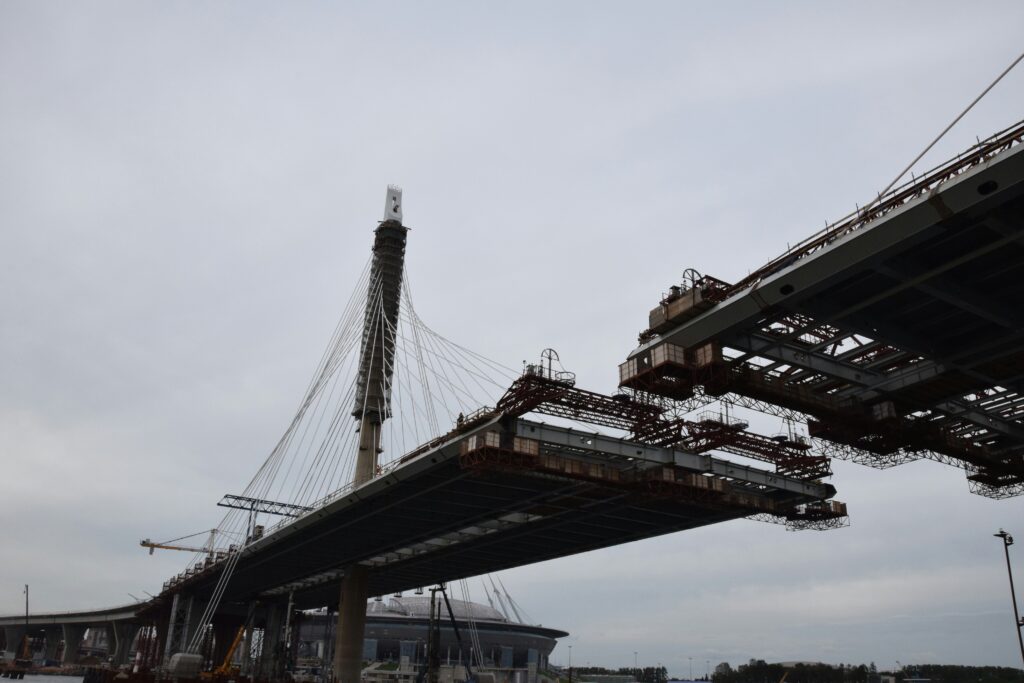
Every bridge — whether a simple beam crossing a stream or a cable-stayed span crossing a major river — is built from the same fundamental structural hierarchy. Understanding the parts of a bridge helps explain how these structures carry enormous loads across gaps that would otherwise be impassable, and why bridge engineering is one of the most complex disciplines in civil engineering. This guide covers every major bridge component from the ground up, explaining what each part is, where it sits in the structure, and what it does.
The Three Main Parts of a Bridge
Every bridge is organized into three primary structural systems that work together to transfer loads from the surface down to the ground:
- Foundation: The hidden underground structure that anchors the bridge to the earth and transfers all loads into stable ground or bedrock.
- Substructure: The visible vertical structure above ground — piers, abutments, and their components — that carries loads from the bridge deck down to the foundation.
- Superstructure: Everything above the substructure — the girders, deck, railings, and expansion joints — that directly supports traffic and transfers its weight to the substructure below.
Understanding this hierarchy makes the function of each individual component clear. Every part of a bridge serves this chain of load transfer — from traffic load on the deck, through the girders, through the bearings, through the piers, through the foundations, and finally into the ground.
Bridge Foundation Components
The foundation is the part of a bridge that the public never sees — buried below ground or beneath the water, it is the most critical element determining whether a bridge can stand safely for its design life of 50, 75, or 100 years.
Open (Shallow) Foundations
Open or shallow foundations are used when the load-bearing soil or rock is close to the surface. They work similarly to building footings — wide concrete slabs that spread the load of the pier above across a large enough area of ground that the bearing pressure remains within safe limits.
The depth and width of open foundations are engineered to resist two critical failure modes: punching shear (where the pier punches down through the footing) and direct shear (where the footing slides sideways under horizontal loads). Open foundations are the most economical choice when ground conditions allow them, but they are unsuitable in soft soils, flood-prone areas, or anywhere the stable ground layer sits too deep.
Piles
Piles are the most common bridge foundation element when shallow foundations are not possible. A pile is a long, slender structural member — typically of reinforced concrete, steel, or timber — driven or cast into the ground to reach stable soil or rock at greater depth.
Piles transfer load in two ways. End-bearing piles drive through soft upper layers and rest on hard stratum or bedrock below, transmitting load through direct compression at the pile tip. Friction piles develop their load-carrying capacity through skin friction along the entire length of the pile shaft, distributing load gradually into the surrounding soil.
Bridge piles are always designed in groups rather than individually. A single pier cap may sit on 3, 4, 6, 8, or more piles depending on the load requirements. Heavy-duty piers in major bridges may use 12 or more piles per cap. The group arrangement ensures load distribution and stability even if one pile has localized defects.
For bridges crossing rivers or water bodies, pile design must account for scour — the erosion of riverbed material around pile bases during high water flow events. Scour can expose pile shafts that were designed to be embedded, dramatically reducing their capacity.
Pile Caps
A pile cap is the thick reinforced concrete slab that sits on top of a group of piles and connects them into a unified foundation unit. It serves two functions: distributing the load from the pier above across all the piles below, and tying the pile group together so they act as a rigid system.
Pile caps are designed for significant bending moments and shear forces as they span between pile heads. They are heavily reinforced and use high-grade concrete to handle these demands. In deep foundations, the pile cap is the transition element between the slender vertical piles and the broader pier base above it.
Bridge Substructure Components
The substructure is the visible portion of a bridge’s supporting system below the deck. It includes everything that stands between the foundation and the load-bearing surface.
Piers
Bridge piers are the vertical compression members that support the bridge spans and transfer loads from the superstructure down to the foundation. They are the most visually prominent part of most bridges — the columns rising from the water or ground that the deck visibly rests on.
Piers must resist both vertical loads (the dead weight of the bridge and the live load of traffic) and horizontal loads (wind, earthquake forces, and the braking forces of vehicles). They experience large axial compression forces combined with bending moments in both the longitudinal and transverse directions simultaneously.
The cross-sectional shape of piers varies widely depending on structural requirements and aesthetic considerations. Circular piers are common for their equal resistance in all horizontal directions and their smooth appearance. Rectangular piers are used where space constraints require a narrow profile. Elongated oval or blade piers are used in rivers to minimize water resistance and scour. Some bridges use multiple columns per pier cap to distribute loads across a wider base.
Pier Caps (Piercaps)
A pier cap (also called a piercap or cap beam) is the horizontal beam that sits on top of the pier columns and supports the bridge girders. It is the transition member between the vertical piers below and the horizontal superstructure above.
The pier cap’s primary function is to receive the loads from multiple girders or bearings distributed along its length and concentrate them into the pier below. It hosts the bearing pedestals, seismic arrestors, drainage provision holes, and in some bridges the launcher sleeves used during construction.
Pier caps are classified as bending members — they span between pier columns like a beam, experiencing bending moments and shear forces. In narrow pier caps where the flange width is small relative to the depth, they may be designed as corbels rather than conventional beams, which requires a different design approach based on strut-and-tie models.
Bearing Pedestals
Bearing pedestals are the small raised platforms on top of the pier cap that position and support the bridge bearings. They are rectangular concrete blocks cast monolithically with the pier cap, typically with a shallow socket about 100mm deep to correctly locate and fix the bearing in position.
The dimensions of bearing pedestals are governed by the dimensions of the bearings they support. They include bursting reinforcement — additional reinforcement provided around the perimeter — to prevent the concentrated load from the bearing from splitting the concrete. In some bridge configurations, bearing pedestals also serve as seismic arrestors, providing restraint against girder movement during earthquake events.
Bearings
Bearings are the interface components that connect the bridge superstructure (girders) to the substructure (pier caps) while allowing controlled relative movement between them. They are one of the most mechanically important parts of any bridge.
Bridge decks and girders move constantly — they expand and contract thermally with temperature changes, deflect under live loads, and experience minor seismic displacements. Without bearings to accommodate this movement, stresses would accumulate in the structure to damaging levels. Bearings allow movement in specific directions while transferring vertical loads efficiently through the connection.
The most common modern bearing types are elastomeric bearings — laminated rubber pads reinforced with steel plates that deform under load and return to their original shape. They accommodate thermal movement through shear deformation of the rubber. Pot bearings and spherical bearings are used in larger bridges where higher loads and greater rotation capacity are required. Bearings are consumable components that require periodic inspection and eventual replacement over the bridge’s service life.
Seismic Arrestors
Seismic arrestors are structural stops that limit the movement of bridge girders during earthquakes, preventing them from being displaced off their supports. They are positioned at the interface between the girder and the pier cap and designed to absorb impact forces in both the transverse and longitudinal directions.
In box girder bridges, the arrestor fits inside a notch in the soffit (underside) of the box girder end segment, with a clearance gap of 50 to 150mm that closes during seismic events. In I-section girder bridges, separate arrestors are placed on the pier cap for each direction of restraint. The clearance gap is critical — it allows normal thermal and traffic movements to occur freely while limiting extreme seismic displacements.
Abutments
Abutments are the substructure elements at the two ends of a bridge where the bridge meets the road or embankment on either side. Every bridge has at least two abutments — one at each end — and single-span bridges have only abutments without intermediate piers.
Abutments serve multiple simultaneous functions. They provide vertical support for the end spans of the bridge girders. They resist the horizontal soil pressure from the embankment fill material behind them, functioning as retaining walls. They provide the structural transition from the flexible bridge deck to the more rigid road pavement on either side. And they anchor the approach slab — the transitional slab that spans the zone of potential settlement between the bridge and the road embankment.
Wing Walls
Wing walls are retaining walls that extend from the abutments at an angle, either perpendicular or diagonal to the bridge span, to retain the approach embankment fill on either side. They prevent the embankment material from spilling out sideways and direct any water flow through the bridge opening rather than around the abutments.
Wing walls may be attached directly to the abutment or constructed as independent structures adjacent to it. Their design depends on the height of the embankment they retain, the soil conditions, and the geometry of the approach. In river bridges, the upstream wing walls are often shaped to guide flow smoothly through the bridge opening, reducing turbulence and scour risk.
Crash Barriers (Pier Protection)
In urban bridges and highway overpasses, crash barriers are provided at the base of piers that are exposed to vehicle traffic below the bridge. These are structural enlargements of the pier section at road level, with additional reinforcement, designed to absorb the sudden impact force of a vehicle collision without allowing the pier itself to be critically damaged.
The design of crash barriers is based on vehicle impact loads specified in bridge design standards — typically a horizontal impact force applied at bumper height. They are not merely aesthetic thickenings but structurally engineered protection against a specific load case.
Bridge Superstructure Components
The superstructure is everything above the substructure — the components that span the gap and directly carry the traffic load. It is the part of the bridge most visible to users and the part that performs the fundamental spanning function.
Girders
Girders are the primary load-carrying elements of the bridge superstructure — they span between supports and transfer the traffic loads from the deck above to the bearings below. They are the structural equivalent of the beams in a building frame, oriented longitudinally along the bridge axis.
Bridge girders come in several forms. I-section girders are the most common — steel or prestressed concrete sections with flanges at top and bottom connected by a vertical web, providing efficient resistance to bending. Box girders are hollow closed sections that provide excellent torsional stiffness in addition to bending resistance, making them ideal for curved bridges and long spans. U-section girders are open-top trough shapes used in rail bridge construction. Steel plate girders use welded steel plates to create custom I-sections for steel bridges.
Girders may be simply supported (resting on two supports with no continuity) or continuous (spanning over multiple supports as a single connected beam). Continuous girders are more structurally efficient but more complex to design and construct.
Deck Slab
The deck slab is the horizontal surface that vehicles and pedestrians actually travel on. It is the topmost structural element of the bridge, spanning between the girders and distributing traffic loads to them.
In composite bridges, the deck slab works together with the girders as a structural system — the concrete deck in compression acting with the steel or concrete girder in tension to create a combined section more efficient than either alone. In box girder bridges, the top flange of the box section itself serves as the deck slab.
Deck slabs are built with a cross-slope — a slight transverse inclination — to drain rainwater toward the sides rather than allowing it to pond on the surface. Drainage inlets or hoses collect this water and direct it away from the structure.
Diaphragms
Diaphragms are transverse walls or frames positioned at intervals between the girders along the length of the bridge. Their primary function is to provide lateral stiffness — resisting forces that act perpendicular to the bridge axis such as wind loads, seismic forces, and the destabilizing effects of unequal loading across the bridge width.
Without diaphragms, individual girders would be vulnerable to lateral buckling and differential movement. Diaphragms tie the girder system together so it acts as a unified structural unit. End diaphragms, positioned at the girder ends over the supports, are particularly important for resisting seismic forces and connecting the girder system to the seismic arrestors in the substructure.
Bracings
Bracings are transverse or diagonal members connecting adjacent girders to provide lateral stability. In steel bridge construction, lateral bracing systems prevent the compression flanges of steel girders from buckling sideways — a failure mode called lateral-torsional buckling that can occur at loads significantly below the theoretical bending capacity of the girder.
Bracing systems are particularly critical during construction before the deck slab has been placed to stabilize the girders. They also distribute live loads laterally across the full width of the bridge, preventing individual girders from being overloaded by eccentric traffic placements.
Crash Parapets
Crash parapets (also called bridge railings or traffic barriers) are the protective walls along the edges of the bridge deck. They prevent vehicles from leaving the deck surface in the event of a collision or loss of control, and provide a physical boundary that defines the usable width of the bridge.
Bridge parapets are designed to absorb specific vehicle impact loads defined in national design standards, typically including both low-speed car impacts and high-speed truck impacts at different performance levels. In addition to their structural function, they often carry utility conduits — cable trays, drainage pipes, lighting fixtures, and signage attachments.
Expansion Joints
Expansion joints are deliberately designed gaps in the bridge deck at specific locations — typically at the ends of spans and at intermediate points in long bridges — that allow the deck to expand and contract freely with temperature changes without developing damaging internal stresses.
Concrete expands when heated and contracts when cooled. A 100-meter concrete deck can change length by 50 to 60mm between summer maximum and winter minimum temperatures. Without expansion joints to accommodate this movement, the resulting thermal stresses would crack the structure over time. Expansion joints must allow this movement while remaining sealed against water infiltration and providing a smooth riding surface for traffic.
The spacing and design of expansion joints is determined during bridge design based on the span lengths, material types, temperature range at the site, and the movement accommodation capacity of the bearing system.
Bridge Superstructure vs Substructure: Key Differences
The distinction between superstructure and substructure is fundamental in bridge engineering but can be confusing for non-specialists.
The superstructure is everything above the bearings — girders, deck, parapets, expansion joints, and utilities. It is what spans the gap and carries the traffic. It is generally replaceable or repairable without decommissioning the entire bridge.
The substructure is everything below the bearings and above the foundation — piers, pier caps, abutments, wing walls, and crash barriers. It supports the superstructure and transfers loads to the foundation. Replacing substructure elements is significantly more costly and disruptive than superstructure replacement.
The foundation, while sometimes grouped with the substructure, is technically a separate category — the buried elements that anchor the bridge to the ground. Foundation failures are the most catastrophic and most expensive to address of any bridge component failure.
Bridge Parts by Bridge Type
Beam Bridge Parts
Beam bridges — the simplest and most common bridge type — use all the components described in this guide in their most straightforward arrangement. Simply supported girders rest on bearings at each end, which sit on pier caps or abutments, which in turn sit on piles or open foundations.
Arch Bridge Parts
Arch bridges have a curved main structural element — the arch — that transfers loads primarily through compression to the abutments at each end. The deck may sit above the arch (deck arch), below it (through arch), or at mid-height. The abutments must be massive in arch bridges because they absorb the horizontal thrust that the arch produces in addition to vertical loads.
Suspension Bridge Parts
Suspension bridges add two unique components: towers and main cables. The towers are tall vertical masts (a type of pier) that support the main cables, which hang in a catenary curve between them. Vertical hanger cables descend from the main cables to support the deck below. The main cables are anchored at each end in massive concrete anchor blocks embedded in the ground. The deck of a suspension bridge hangs rather than sits, supported by the cable system above it.
Cable-Stayed Bridge Parts
Cable-stayed bridges also use towers and cables but with a different arrangement — the cables connect directly from the tower to the deck at multiple points rather than through a suspended main cable. The deck itself must be designed to resist significant compression forces from the angled cable pulls.
Frequently Asked Questions
What are the main parts of a bridge?
Every bridge has three main structural systems: the foundation (piles, pile caps, or open footings buried in the ground), the substructure (piers, pier caps, abutments, bearings, and related components above ground), and the superstructure (girders, deck slab, parapets, expansion joints, and everything that spans the gap and carries traffic). Each system transfers loads to the one below it, ultimately delivering all bridge loads safely into the ground.
What is the bottom part of a bridge called?
The bottom part of a bridge is called the foundation. It consists of piles (long structural members driven into the ground), pile caps (concrete slabs connecting the pile tops), or open footings (shallow spread foundations) depending on soil conditions. The foundation is always buried below ground or below the river bed and is not visible in the finished bridge.
What are bridge supports called?
The vertical supports of a bridge are called piers (for intermediate supports between the ends) and abutments (for the supports at each end where the bridge meets the road). Both transfer loads from the superstructure through bearings to the foundations below. The horizontal beam on top of a pier that the girders rest on is called the pier cap or cap beam.
What is the underside of a bridge called?
The underside of a bridge deck or girder is called the soffit. In box girder bridges, the soffit is the bottom surface of the closed box section. The soffit of the end segment of a box girder bridge often contains notches or openings to accommodate seismic arrestors. The space under a bridge between the piers and the deck is called the clearance zone.
What is a bridge deck?
A bridge deck is the surface that vehicles, cyclists, and pedestrians travel on. It is the topmost structural element of the bridge superstructure, typically a reinforced or prestressed concrete slab spanning between girders. The deck has a cross-slope for drainage and is protected by a wearing surface or asphalt overlay. In box girder bridges, the top flange of the box section serves as the deck slab.
Final Thoughts
Every bridge, from a simple country road crossing to a major harbor span, is built from the same fundamental components organized into the same three-level hierarchy. The foundation anchors the structure in the earth. The substructure raises it to the required height and transfers loads downward. The superstructure spans the gap and supports everything that crosses it.
What makes bridge engineering remarkable is how each of these components must be precisely sized for the specific loads, soil conditions, span lengths, and environmental conditions of a particular site — and how they must all work together as a unified system that remains safe and serviceable for a century or more.