
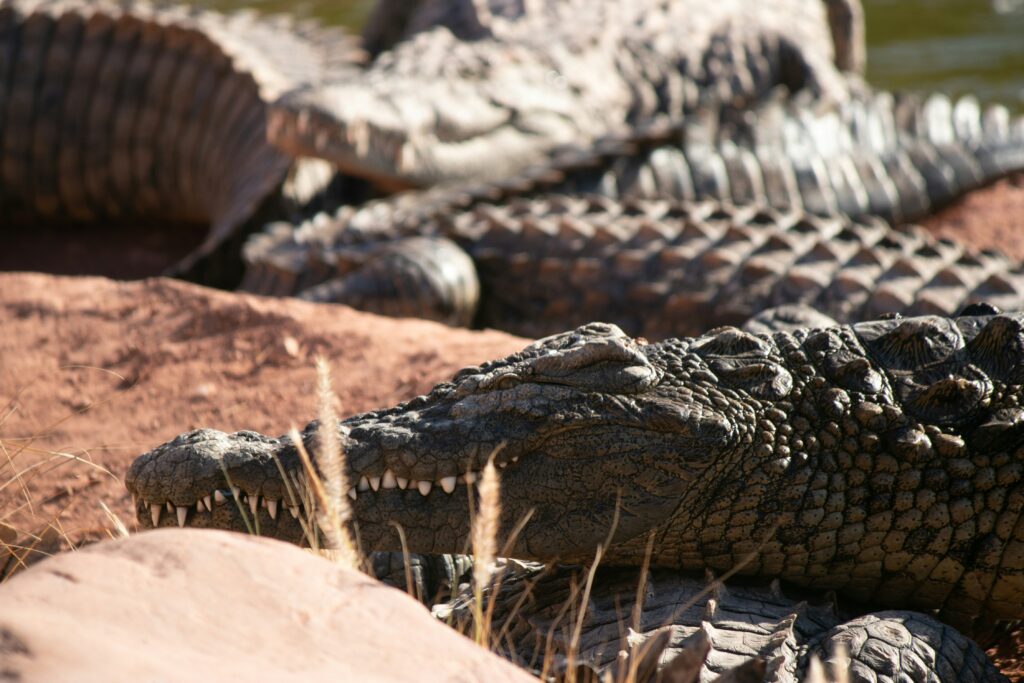
Here is the single most important fact you need to know: crocodiles kill approximately 1,000 people per year in Africa alone. American alligators kill fewer than one person per year in the United States, despite Florida’s population exceeding 22 million people. These are not equally dangerous animals.
Crocodiles are larger, more aggressive, and actively view humans as prey. Alligators typically avoid human confrontation and have never been recorded intentionally hunting humans. The confusion between the two comes from how similar they look — but they are different species, from different families, found in different parts of the world, and they behave very differently.
Here is the complete comparison: which is more dangerous, how to tell them apart instantly, where each one lives, and what to do if you encounter either one.
Crocodile vs Alligator: Quick Comparison
| Feature | Crocodile | Alligator |
| Snout shape | V-shaped, narrow and pointed | U-shaped, wide and rounded |
| Teeth when mouth closed | Both rows visible | Upper teeth only visible |
| Size | Up to 23 ft (saltwater); avg 10–17 ft | 8–14 ft typically; max ~15 ft |
| Weight | Up to 2,200 lbs (saltwater) | Up to 1,000 lbs |
| Color | Olive green to tan/gray | Dark gray to nearly black |
| Where they live | Africa, Asia, Americas, Australia | Southeastern US, China |
| Saltwater tolerance | Yes — some species thrive in ocean | Rarely — prefer freshwater |
| Aggression toward humans | High — especially Nile and saltwater | Low — generally avoid humans |
| Annual human fatalities | ~1,000 in Africa (Nile crocodile) | < 1 per year in US |
| Speed on land | Up to 22 mph in short bursts | Up to 35 mph in very short bursts |
| Lifespan | 50–75 years | 30–50 years (up to 80 in captivity) |
Are Crocodiles More Dangerous Than Alligators? The Answer Is Clear
Yes — crocodiles are significantly more dangerous to humans than alligators. The difference is not subtle. According to a 2025 study by researchers from the University of Florida and Central College in Kentucky, alligators do not intentionally hunt humans. In 96% of recorded alligator attacks, the encounter involved swimming in prohibited areas, nighttime activity near water, walking dogs near water, or attempting to feed the reptiles.
Crocodiles — specifically the Nile crocodile and the saltwater crocodile — actively view large mammals, including humans, as prey. They do not need provocation to attack. Saltwater crocodiles are responsible for dozens of deaths annually in Southeast Asia and northern Australia. Nile crocodiles are responsible for most of the approximately 1,000 human deaths per year in Africa.
The contrast in US terms is stark: since 1948, approximately 500 alligator attacks have been recorded in the United States, with 31 fatalities over more than 75 years — less than one fatality per year. In parts of Africa with Nile crocodile populations, the same number of deaths can occur in a single month.
How to Tell a Crocodile from an Alligator Instantly
1. Look at the Snout
This is the fastest way. Crocodiles have a V-shaped, narrow, pointed snout. Alligators have a U-shaped, wide, rounded snout. The alligator’s broader snout is adapted for crushing hard-shelled prey like turtles. The crocodile’s narrower snout is designed for catching fish.
2. Check the Teeth When the Mouth Is Closed
In an alligator, the upper jaw is wider than the lower jaw, so when the mouth closes, the lower teeth fit inside the upper jaw and are hidden — you see only the upper teeth. In a crocodile, the fourth tooth on the lower jaw is particularly large and sticks out when the mouth is closed. If you can see both rows of teeth when the mouth is shut, it is almost certainly a crocodile.
3. Color
Alligators are the darkest of all living crocodilians — adult alligators are very dark gray to nearly black. American crocodiles are lighter, with a grayish-green or olive color and pale white to yellowish undersides.
4. Location
In the United States, if you see a large crocodilian in the wild, it is almost certainly an alligator unless you are in a very specific part of southern Florida — the only place in the US where American crocodiles live (in the brackish coastal waters of South Florida and the Florida Keys). If you see one anywhere else in the US, it is a gator.
If you are planning wildlife travel and want to see these animals safely, our guide to crocodiles in Costa Rica and the best viewing locations covers the best — and safest — spots to observe wild crocodiles.
Size: Which Is Bigger — Crocodile or Alligator?
Crocodiles are generally larger, though the exact comparison depends heavily on the species. The largest crocodile species — the saltwater crocodile (Crocodylus porosus) — is the largest living reptile on Earth. Saltwater crocodiles regularly exceed 17 feet and can reach 23 feet in length, weighing over 2,200 pounds. Even average adult males reach 14–17 feet.
American alligators are the largest reptile in North America, typically reaching 8–14 feet in length and weighing up to 1,000 pounds. The largest reliably recorded American alligator was just under 15 feet. Impressive — but the saltwater crocodile dwarfs it.
Nile crocodiles, found throughout sub-Saharan Africa, are also consistently larger than alligators — typically 11–16 feet, with exceptionally large individuals exceeding 20 feet. The largest reliably measured Nile crocodile on record was just over 21 feet.
Crocodile Teeth vs Alligator Teeth
Both crocodiles and alligators have approximately 80 teeth, and both continuously replace lost teeth throughout their lives — a single animal may go through 3,000 teeth in a lifetime. But the arrangement is different:
- Alligators: The upper jaw is noticeably wider than the lower jaw. When the mouth closes, the lower teeth fit inside the upper jaw — you see only the upper row of teeth
- Crocodiles: Upper and lower jaws are more equal in width. Both rows of teeth are visible when the mouth is closed. The fourth lower tooth is particularly prominent and fits into a notch in the upper jaw
Bite force differs between species but not dramatically between alligators and crocodiles of similar size. Both have among the strongest bites of any living animal — sufficient to crush turtle shells, bones, and thick hides.
Where Do Crocodiles vs Alligators Live?
Alligators
There are two species of alligator: the American alligator and the Chinese alligator (critically endangered, found in eastern China). American alligators live exclusively in the southeastern United States — primarily Florida, Louisiana, Alabama, Georgia, South Carolina, and parts of Texas. They strongly prefer freshwater: rivers, lakes, swamps, and marshes. They can tolerate slightly brackish water but are rarely found in fully saltwater environments.
Crocodiles
Crocodiles are much more geographically widespread — found across Africa, Asia, Australia, and the Americas. Key species include:
- Saltwater crocodile: India, Southeast Asia, northern Australia — tolerates full ocean saltwater and has been found hundreds of miles offshore
- Nile crocodile: Throughout sub-Saharan Africa and the Nile river system — responsible for most crocodile attacks on humans globally
- American crocodile: Southern Florida, Central America, northern South America — much rarer than the alligator; shy and generally less aggressive than Nile or saltwater crocodiles
- Mugger crocodile: India and Sri Lanka
Are there crocodiles in Louisiana? No — Louisiana has alligators, not crocodiles. American crocodiles are limited to southern Florida. Are there crocodiles in North Carolina? No — alligators can be found in coastal North Carolina at the northern edge of their range, but no crocodile species live there.
Gharial: The Third Member of the Family
The difference between crocodile, alligator, and gharial is another common question. The gharial (or gavial) is a third family of crocodilian, found in the Indian subcontinent. It has an extremely long, narrow snout with 110 interlocking teeth — adapted almost exclusively for catching fish. Gharials are critically endangered and extremely shy of humans. Unlike crocodiles and alligators, gharials pose virtually no threat to people.
Were Crocodiles Alive With Dinosaurs?
Yes — crocodilians are one of the most ancient lineages of living vertebrates. They coexisted with dinosaurs throughout the Mesozoic Era (approximately 252–66 million years ago) and survived the mass extinction event that wiped out the non-avian dinosaurs 66 million years ago. Modern crocodiles and alligators are not the same species as Mesozoic crocodilians, but they are direct evolutionary descendants. Crocodilians have changed relatively little in 80–100 million years — making them one of the most successful evolutionary lineages in Earth’s history.
Is a Crocodile an Amphibian?
No. Crocodiles are reptiles, not amphibians. The key difference: amphibians (frogs, salamanders, newts) have moist, permeable skin, typically spend part of their life cycle in water as larvae (like tadpoles), and cannot regulate their body temperature. Crocodiles and alligators are reptiles with thick, scaly, waterproof skin, are air-breathing throughout their lives, and are ectothermic (cold-blooded) but in a different way than amphibians.
What to Do If You Encounter a Crocodile or Alligator
If you encounter an alligator:
- Back away slowly — alligators generally retreat from humans unless cornered or protecting a nest
- Never feed an alligator — feeding habituates them to humans and dramatically increases attack risk
- Stay well away from the water’s edge, especially at dawn, dusk, and night when they are most active
- Keep dogs on leashes and away from water — dogs are frequently targeted because they resemble prey
If you encounter a saltwater or Nile crocodile:
- Take them far more seriously than alligators — these species actively hunt large mammals and will approach rather than retreat
- Never approach water in areas with known saltwater or Nile crocodile populations without local knowledge
- If charged on land, run in a straight line — the sprint speed claim that crocodiles cannot run in a zigzag is a myth; running in a straight line as fast as possible is the correct response
The Florida Fish and Wildlife Conservation Commission maintains current data on alligator incidents and safety guidelines at myfwc.com — useful for Florida residents and visitors.
Bottom Line
| ✅ More dangerous? | Crocodiles — kill ~1,000 people/year in Africa vs < 1/year from alligators in US |
| ✅ Bigger? | Crocodiles — saltwater croc up to 23 ft vs alligator max ~15 ft |
| ✅ Tell them apart | Snout shape: V (croc) vs U (gator); teeth visible = croc |
| ✅ US location | Alligators = southeast US; American crocodile = southern Florida only |
| ✅ Aggression | Crocs actively hunt large mammals; gators generally avoid humans |
| ✅ Ancient? | Both coexisted with dinosaurs — crocodilians unchanged for ~80 million years |
Frequently Asked Questions
Are crocodiles more dangerous than alligators?
Yes, significantly. Crocodiles — particularly Nile and saltwater species — kill approximately 1,000 people per year in Africa and are among the world’s most dangerous animals. American alligators kill fewer than one person per year in the United States and do not intentionally hunt humans, according to a 2025 University of Florida study.
Which is bigger, a crocodile or an alligator?
Crocodiles are generally larger. The saltwater crocodile is the largest living reptile, reaching up to 23 feet and over 2,200 pounds. American alligators typically reach 8–14 feet and up to 1,000 pounds, with the largest recorded specimen just under 15 feet.
How do you tell a crocodile from an alligator?
The fastest method: look at the snout. Crocodiles have a V-shaped, narrow, pointed snout. Alligators have a U-shaped, wide, rounded snout. Also, when a crocodile’s mouth is closed, both rows of teeth are visible. When an alligator’s mouth is closed, only the upper teeth show.
Are there crocodiles in Louisiana?
No. Louisiana has American alligators — one of the densest alligator populations in the US. American crocodiles are only found in southern Florida. No crocodile species lives naturally in Louisiana.
Is a crocodile an amphibian?
No. Crocodiles are reptiles. Amphibians include frogs, salamanders, and newts — animals with permeable skin that typically have aquatic larval stages. Crocodiles are air-breathing reptiles with thick, waterproof, scaly skin throughout their entire life cycle.
Were crocodiles alive when dinosaurs existed?
Yes. Crocodilians coexisted with dinosaurs throughout the Mesozoic Era and survived the mass extinction event 66 million years ago that killed the non-avian dinosaurs. Modern crocodiles are direct evolutionary descendants of Mesozoic crocodilians and have changed relatively little in 80–100 million years.