
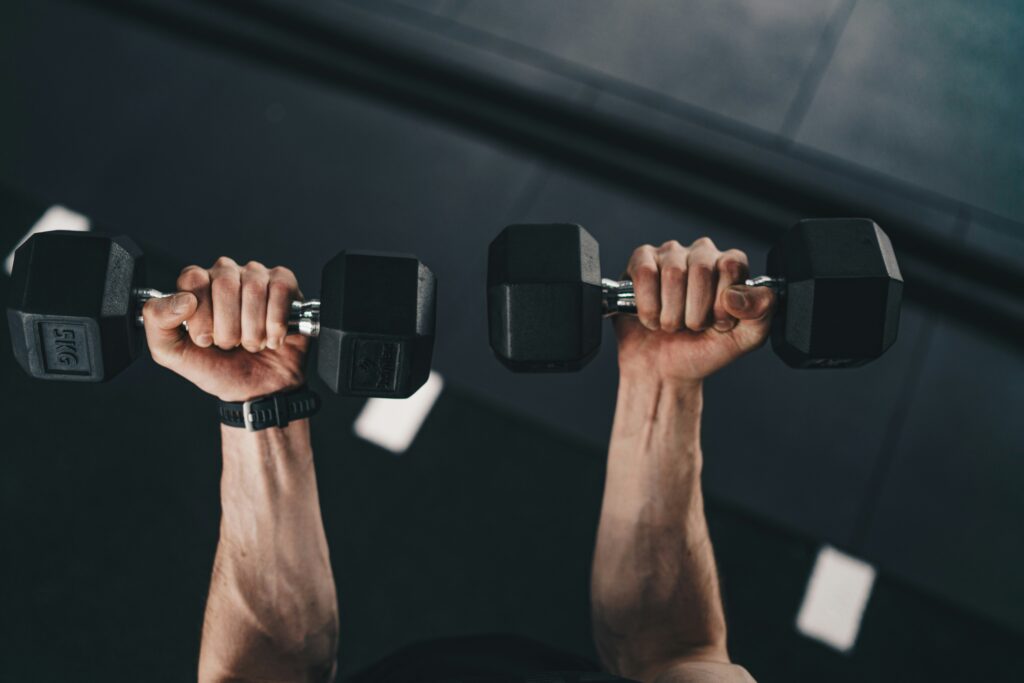
Hammer curls and bicep curls look almost identical — same starting position, same basic movement, both build the upper arm. The difference is the grip, and that one change in grip shifts the muscular emphasis significantly. Here is a complete breakdown of what each exercise works, why the grip matters, and how to structure both movements for maximum arm development.
The Key Difference: Grip
| Hammer Curl | Bicep Curl | |
| Grip | Neutral (palms facing each other, thumbs up) | Supinated (palms facing up/ceiling) |
| Primary muscle | Brachialis | Biceps brachii |
| Secondary muscle | Biceps brachii | Brachialis |
| Forearm muscle | Brachioradialis (more active) | Brachioradialis (less active) |
| Weight typically used | Heavier (neutral grip is mechanically stronger) | Slightly lighter |
| Best for | Overall arm thickness; forearm size | Bicep peak; short head and long head development |
Hammer Curl Muscles Worked
The neutral grip of the hammer curl changes which muscles do the most work:
Brachialis (Primary)
The brachialis is a muscle that sits beneath the biceps brachii — it is the true workhorse of elbow flexion, responsible for approximately 60% of total elbow flexion strength. Unlike the biceps, which also supinates the forearm, the brachialis is a pure flexor — it works maximally in all grip positions. In neutral grip (hammer curl), the biceps’ supination advantage is eliminated, forcing more of the load onto the brachialis.
Why this matters for aesthetics: A well-developed brachialis pushes the bicep upward from underneath, creating a higher bicep peak and greater overall upper arm width. Building the brachialis is one of the most effective ways to add apparent size to the arm even without increasing bicep size directly.
Biceps Brachii (Secondary)
The biceps brachii is still working during hammer curls — it is an elbow flexor regardless of grip — but it is not in its optimal position. The biceps is also the primary supinator of the forearm; in a supinated grip (standard curl), the biceps can generate maximum torque because supination and flexion both contribute. In neutral grip, the supination component is removed, reducing the biceps’ mechanical advantage and shifting proportionally more load to the brachialis.
Brachioradialis (Secondary)
The brachioradialis is a forearm muscle running along the outer edge of the forearm (the radial side). It is most active during neutral grip movements. Hammer curls are one of the best exercises for building the brachioradialis — contributing to forearm size and the thick appearance of the outer forearm when viewed from the front.
Bicep Curl Muscles Worked
The supinated grip of the standard bicep curl optimizes the biceps brachii’s contribution:
Biceps Brachii (Primary)
With the palms facing up (supinated), the biceps brachii is in its strongest position for both flexion and supination simultaneously. The two heads of the biceps — the long head (which crosses the shoulder joint and contributes to the bicep peak when viewed from the side) and the short head (which contributes to bicep width) — are both actively engaged. This supinated position is why the standard curl is the fundamental bicep exercise — it loads the biceps at its mechanical advantage.
Brachialis (Secondary)
The brachialis is still working during standard curls, just less so than during hammer curls. Since the biceps is maximally recruited in supinated grip, the brachialis takes a proportionally smaller share of the total load.
Which Curl Builds More Arm Mass?
The honest answer: both are necessary for complete arm development, and neither is objectively better — they train overlapping but distinct muscular emphasis.
- For bicep peak and definition: standard curls (supinated grip) win — the long head of the biceps, which creates the peaked appearance when flexed, is optimally loaded in the supinated position
- For overall upper arm thickness and width: hammer curls win — the brachialis development pushes the bicep upward and increases the arm’s circumference even when the biceps are not flexed
- For forearm development: hammer curls win — the brachioradialis is much more active in neutral grip
- For total weight moved and strength: hammer curls — most lifters can handle more weight with neutral grip because the combined brachialis-brachioradialis contribution is stronger than the supinated bicep-dominant pattern
Most effective approach: program both. A typical arm session might include standard EZ bar or dumbbell curls (supinated) as the primary bicep movement, followed by hammer curls (neutral grip) as the secondary movement. This covers both the bicep-dominant and brachialis-dominant pathways. The combination produces broader, thicker, more complete arm development than either exercise alone.
Incline Hammer Curls
Incline hammer curls are performed on an adjustable bench set to approximately 45-60 degrees. You sit with your back against the inclined bench and let your arms hang straight down behind your body — rather than at your sides as in standing curls. This position creates a longer range of motion and a greater stretch on the brachialis and biceps at the bottom of the movement.
Why incline hammer curls are particularly effective:
- The shoulder extension position (arms hanging behind the body) places the long head of the biceps under a greater stretch at the bottom of the movement — increasing time under tension and activating more muscle fibers throughout the range of motion
- The incline removes the ability to cheat by swinging the body — strict form is enforced by the bench position
- The greater stretch at the bottom combined with the neutral grip makes incline hammer curls one of the most effective variations for brachialis and bicep long head development simultaneously
- Studies on muscle activation consistently show that stretching a muscle under load (as at the bottom of an incline curl) produces greater hypertrophic stimulus than exercises that only load the muscle in the contracted position
How to perform incline hammer curls:
- Set bench to 45-60 degrees incline
- Sit with your back flat against the pad, feet flat on the floor
- Hold dumbbells with a neutral grip (thumbs pointing forward), arms hanging straight down
- Curl both dumbbells simultaneously (or alternating) to shoulder height, keeping elbows stationary
- Lower slowly — control the eccentric (lowering) phase for 2-3 seconds
- Do not allow the elbows to swing forward at the top of the movement
Hammer Curl Bar and Equipment Options
Dumbbells (Standard)
The vast majority of hammer curls are performed with dumbbells — they are the most natural fit for the neutral grip. Standard dumbbell hammer curls can be performed standing, seated, or on an incline bench. Alternating arms (one at a time) or simultaneous — both are effective. Alternating allows slightly more focus per rep; simultaneous is more time-efficient.
EZ Bar (Close-Grip)
The EZ curl bar — the angled barbell found on most preacher curl benches — has angled grips that place the hands in a partially neutral position (semi-pronated rather than fully supinated). Using the close-grip angled section of an EZ bar approximates the neutral grip of a hammer curl and loads the brachialis and brachioradialis more than a straight barbell. It is not identical to a true neutral grip dumbbell hammer curl, but it is the closest barbell variation. The EZ bar is easier on the wrists than a straight barbell for most people.
Cable Rope (Rope Hammer Curls)
Attaching a rope to a low cable pulley and curling with a neutral grip performs a hammer curl pattern with cable resistance. The cable maintains constant tension throughout the entire range of motion — unlike free weights, where the resistance curve changes as the angle of the weight changes. Cable rope hammer curls are particularly effective for the contracted (top) portion of the movement, where free weights tend to be less loading. The rope also allows the hands to spread slightly at the top for additional brachialis squeeze.
Hammer Curl Machine
Some commercial gyms have dedicated plate-loaded or selectorized machines for neutral-grip curls. The most well-known is Hammer Strength’s line of plate-loaded isolation machines. Machine hammer curls provide a guided movement path, consistent resistance throughout the range of motion, and allow training to muscular failure more safely than free weights. They are useful for isolation work and as a finishing exercise at the end of an arm session.
What Is the Hammer Strength Incline Press?
The Hammer Strength Incline Press is a specific piece of gym equipment — a plate-loaded machine manufactured by Hammer Strength (a brand owned by Life Fitness). It is one of the most popular chest press machines in commercial gyms worldwide.
Key characteristics of the Hammer Strength Incline Press:
- Plate-loaded: Uses standard Olympic weight plates, not a weight stack
- Independent arm movement: Each arm operates independently on its own lever — this allows a more natural range of motion and helps correct strength imbalances between sides
- Diverging/converging path: The arms move in an arc that mimics the natural pressing movement of the pectorals — outward at the bottom of the range and inward at the top
- Angle: The incline targets the upper pectoralis major (clavicular head), along with the anterior deltoid and triceps
This machine is a staple in bodybuilding-oriented gym programs and is frequently used by professional athletes and powerlifters for accessory chest work. It has nothing to do with dumbbell or curl exercises — it is a chest pressing machine that simply shares the ‘Hammer’ brand name.
How to Program Hammer Curls and Bicep Curls Together
For most gym-goers training for arm hypertrophy (muscle size), the most efficient approach is pairing both curl variations in the same session:
- Exercise 1 — Primary bicep movement: EZ bar curls or dumbbell supinated curls; 3-4 sets of 8-12 reps; focus on full supination at the top and controlled eccentric
- Exercise 2 — Hammer curl variation: Standing dumbbell hammer curls or incline hammer curls; 3-4 sets of 10-15 reps; use slightly more weight than standard curls
- Optional Exercise 3 — Cable rope hammer curls: 2-3 sets of 12-15 reps for constant tension and finishing pump
Training frequency: most intermediate and advanced lifters train biceps 2x per week directly, allowing 48-72 hours of recovery between sessions. Muscles grow during recovery, not during the workout itself — adequate protein intake (approximately 0.7-1g per pound of bodyweight) and sleep are as important as the training stimulus.
Frequently Asked Questions
What is the difference between hammer curls and bicep curls?
The grip. Hammer curls use a neutral grip (palms facing each other, thumbs pointing up) which primarily targets the brachialis and brachioradialis. Standard bicep curls use a supinated grip (palms facing up) which primarily targets the biceps brachii. Both exercises work all three muscles — the grip shifts which muscle receives the greatest load.
What muscles do hammer curls work?
Hammer curls primarily work the brachialis (the muscle underneath the bicep), with significant involvement from the biceps brachii and brachioradialis (outer forearm). The brachialis contributes approximately 60% of elbow flexion strength and is best developed with neutral-grip movements like hammer curls.
Are hammer curls or bicep curls better for arm size?
Both are necessary for complete arm development. Standard bicep curls are superior for bicep peak and definition. Hammer curls are superior for overall arm thickness (brachialis development pushes the bicep up) and forearm size. Doing both produces better arm development than relying on either alone.
What are incline hammer curls?
Incline hammer curls are performed on a bench set to 45-60 degrees, with arms hanging straight down behind the body. The incline position creates a greater stretch on the brachialis and long head of the biceps at the bottom of the movement, increasing time under tension and maximizing muscle activation throughout the range of motion.
What is the Hammer Strength incline press?
The Hammer Strength Incline Press is a plate-loaded chest press machine made by Hammer Strength (a Life Fitness brand). It features independent arm levers that move in a natural diverging/converging arc targeting the upper pectoralis major. It is a piece of gym equipment, not a free-weight exercise.
Final Thoughts
Hammer curls and bicep curls are not competing exercises — they are complementary. Standard curls build the biceps brachii in its strongest position; hammer curls build the brachialis and brachioradialis that give the arm its overall thickness and width. The brachialis specifically is one of the most underworked muscles in typical arm training, and developing it is one of the most effective ways to add visible arm size without just making the bicep itself bigger. Program both in your routine, prioritize the incline variation for maximum brachialis stretch, and use the cable rope version for constant tension work. Arms respond well to variety — and these two movements cover the full spectrum of elbow flexor development more completely than either could alone.