
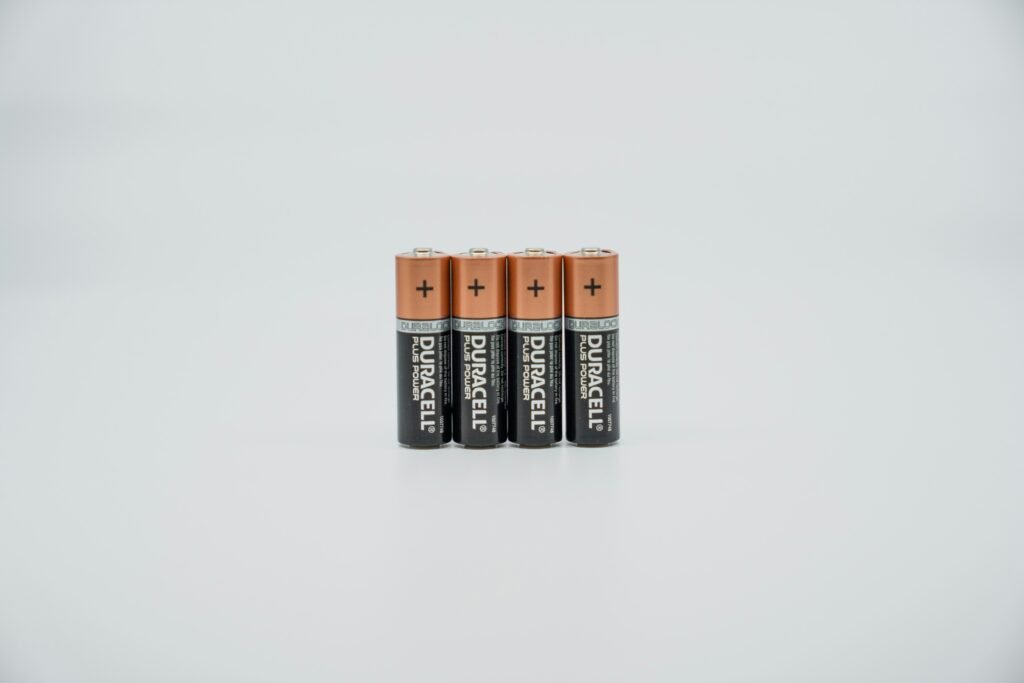
Beyond the everyday AA and D batteries sits a world of specialty battery types — rechargeable lithium-ion cells, the compact N battery, coin cells like the LR44, obscure designations like E90, budget brands like LICB, and international designations like UM-1 and UM-5. This guide covers all of them: how rechargeable li-ion batteries work, lithium AAA options, how to recharge rechargeable batteries correctly, N battery dimensions and equivalents, LR44 replacements, E90 battery equivalents, and what LICB batteries are.
For 1.5V battery basics — AA voltage, D battery voltage, AA dimensions, and the full battery sizes chart, see our article on 1.5V battery guide — AA voltage, D battery voltage, AA dimensions, and battery sizes explained.
Rechargeable Li-Ion Battery — How They Work
Lithium-ion (Li-ion) rechargeable batteries are the dominant rechargeable battery technology in consumer electronics — they power smartphones, laptops, tablets, wireless earbuds, electric vehicles, and thousands of other devices. Unlike standard 1.5V alkaline batteries, Li-ion cells operate at a nominal voltage of 3.6V to 3.7V per cell, with a charge voltage of 4.2V and a discharge cutoff of typically 2.5-3.0V.
How Li-Ion Batteries Work
Lithium-ion batteries work by moving lithium ions between a graphite anode and a lithium metal oxide cathode through a liquid or gel electrolyte. During charging, lithium ions move from the cathode to the anode and are stored there. During discharge (use), the ions move back to the cathode, generating electron flow (electrical current) in the external circuit. This reversible electrochemical process is what makes Li-ion batteries rechargeable — the same reaction can be repeated hundreds to thousands of times.
| Li-Ion Battery Characteristic | Specification |
| Nominal voltage per cell | 3.6V to 3.7V |
| Charge voltage | 4.2V (overcharging damages the cell) |
| Discharge cutoff | 2.5-3.0V (deep discharge damages the cell) |
| Typical cycle life | 300-500 cycles (consumer grade); 1,000+ (quality cells) |
| Self-discharge rate | 1-2% per month (very low) |
| Energy density | 150-300 Wh/kg (highest of common rechargeable types) |
| Temperature sensitivity | Do not charge below 0°C; avoid above 45°C while charging |
Rechargeable Li-Ion Battery vs NiMH — Which Is Better?
| Factor | Li-Ion | NiMH (AA/AAA rechargeable) |
| Voltage per cell | 3.6-3.7V | 1.2V |
| Energy density | Higher | Lower |
| Memory effect | None | Minimal (low-self-discharge NiMH) |
| Self-discharge | 1-2%/month | 15-30%/month (standard); 1-3%/month (LSD) |
| Cycle life | 300-1,000+ | 500-1,000 |
| Form factor | Custom packs; 18650; 21700 | AA, AAA standard sizes |
| Best use | Phones, laptops, power tools | Remotes, toys, flashlights, cameras |
Lithium AAA Battery — Are There Lithium Primary and Rechargeable AAA Options?
Yes — there are two types of lithium AAA batteries, which are easily confused:
Lithium Primary AAA Battery (Not Rechargeable)
Energizer Ultimate Lithium and similar brands make lithium iron disulfide AAA batteries — these are non-rechargeable primary batteries that deliver 1.5V (same as alkaline AAA) but with superior performance: longer shelf life (up to 20 years), better performance in extreme temperatures (-40°C to 60°C), lighter weight, and flatter discharge curve. These are the best choice for devices that sit unused for long periods (emergency flashlights, smoke detectors) or that are used in very cold environments.
Li-Ion Rechargeable AAA Battery
True Li-ion rechargeable AAA batteries (3.7V cells in AAA size) exist but are less common in consumer products — most AAA-slot devices are designed for 1.5V and a 3.7V cell would damage them. What is more common are USB-rechargeable AAA batteries (like EBL or Kentli brand) that use a built-in voltage converter to deliver 1.5V output from a Li-ion core — compatible with standard AAA devices and rechargeable via USB. NiMH rechargeable AAA batteries (like Eneloop AAA) are the most practical rechargeable option for standard AAA devices, delivering 1.2V nominal which works in the vast majority of 1.5V AAA devices.
How to Recharge Rechargeable Batteries — Complete Guide
How to Recharge NiMH AA/AAA Batteries
- Use a compatible NiMH charger — do not use a Li-ion charger for NiMH batteries
- Insert batteries in the correct polarity (+ to + and – to -) as marked in the charger
- Plug in the charger and allow batteries to charge fully — standard chargers take 8-16 hours; fast chargers take 1-4 hours
- Remove batteries when charging is complete — leaving batteries in chargers long-term can reduce capacity over time with basic chargers
- Use a smart charger (like Panasonic BQ-CC17 or La Crosse BC-700) for best results — these detect when charging is complete and switch to maintenance mode
How to Recharge Li-Ion Batteries
- Use only the manufacturer-approved charger or a quality universal charger rated for the specific Li-ion cell voltage
- Never charge Li-ion batteries at temperatures below 0°C or above 45°C — this causes permanent damage and safety risks
- Do not fully discharge Li-ion batteries before recharging — partial charges are fine and actually extend cycle life
- Avoid leaving Li-ion batteries at 100% charge for extended periods — storing at 40-60% charge is optimal for long-term health
- For 18650 cells used in flashlights, vaping devices, and DIY power banks: use a dedicated 18650 charger (Nitecore, Xtar, or Opus brands are well regarded)
How to Recharge AA Rechargeable Batteries — Common Questions
- Can you recharge alkaline AA batteries? No — standard alkaline batteries are not designed for recharging. Attempting to recharge them can cause leakage, rupture, or in rare cases fire. Only batteries labeled ‘rechargeable’ should be recharged.
- How many times can you recharge NiMH AA batteries? Quality NiMH batteries like Panasonic Eneloop handle 500-2,100 charge cycles depending on the grade.
- How long to charge AA rechargeable batteries? Standard chargers: 8-16 hours. Fast chargers: 1-4 hours. Quick chargers (15-minute): not recommended for regular use as they stress the battery.
N Battery — Size, Dimensions, and Equivalents
The N battery (also called N size, LR1, or Lady battery) is a small cylindrical battery less commonly found in everyday devices but important in specific applications.
| N Battery Specification | Value |
| Voltage | 1.5V (same as AA/AAA/C/D) |
| Diameter | 12.0 mm (0.472 inches) |
| Height/Length | 30.2 mm (1.189 inches) |
| Capacity | 800-1,000 mAh (typical alkaline) |
| IEC designation | LR1 (alkaline) / R1 (carbon-zinc) |
| Other names | Lady battery; E90; MN9100; UM-5 |
What Devices Use N Batteries?
N batteries are used in: certain medical devices (blood pressure monitors, glucometers), vintage calculators and cameras, some security system keypads, specialized flashlights, certain hearing aid devices, and some older cordless phone handsets. The N battery’s compact size (smaller than AAA but delivering 1.5V) suits devices where AAA would be too large.
N Battery Equivalent — What Can Replace an N Battery?
There is no direct substitution for an N battery from a standard consumer battery size — it is a unique form factor. However:
- N battery = LR1 = E90 = MN9100 = UM-5 = Lady battery — these are all the same battery with different regional or manufacturer designations
- Duracell MN9100, Energizer E90, and Rayovac N all refer to the same N battery
- Some N battery devices can accept a AA battery with an adapter sleeve if you need a temporary fix — check your device dimensions
- LICB brand also makes N batteries under their product line
LR44 1.5V Battery — Uses, Equivalents, and Replacements
The LR44 is one of the most common button cell (coin cell) batteries — a small, round, flat battery used in many small electronic devices.
| LR44 Specification | Value |
| Voltage | 1.5V (alkaline) |
| Diameter | 11.6 mm |
| Height | 5.4 mm |
| Capacity | 150 mAh (typical alkaline) |
| Chemistry | Alkaline (LR prefix) |
LR44 Battery Equivalents
The LR44 has many equivalent designations used by different manufacturers and regional standards:
| Designation | Notes |
| LR44 | Standard IEC alkaline designation |
| AG13 | Common Chinese/Asian market designation for alkaline version |
| A76 | Duracell’s designation |
| 357 | Common watch battery designation (silver oxide version) |
| SR44 | Silver oxide equivalent — same size, better performance for watches |
| GPA76 | Another alkaline designation |
| V13GA | Varta’s alkaline designation |
Important distinction: LR44 (alkaline) and SR44 (silver oxide) are the same physical size and are interchangeable in most devices. However, SR44 is the preferred choice for watches and precision instruments because silver oxide maintains more consistent voltage throughout discharge — alkaline voltage drops gradually while silver oxide stays flat until nearly depleted. For non-precision devices like toy games, calculators, and key fobs, LR44 alkaline works perfectly well.
E90 Battery Equivalent — What Is the E90 Battery?
The E90 is Energizer’s brand designation for the N battery (LR1). It is not a unique battery type — it is simply Energizer’s model number for their N/LR1 battery. When you see ‘E90 battery’ on a device or in a parts list, you need an N size battery (LR1). Equivalents:
| Designation | Brand/Region |
| E90 | Energizer (US) |
| MN9100 | Duracell (US) |
| LR1 | IEC international standard |
| AM5 | Panasonic (Japan) |
| UM-5 / UM5 | Japanese industry standard |
| N | ANSI (US) standard |
| Lady | European common name |
| 910A | Varta designation |
LICB Battery — What Is LICB?
LICB is a battery brand — not a battery type or chemistry designation. LICB (sometimes spelled Li-CB or LICB) is a Chinese battery manufacturer that produces a range of alkaline, lithium, and specialty batteries including N batteries, LR44 button cells, CR2032 coin cells, AA, AAA, and other common sizes. LICB batteries are primarily sold through Amazon and are known for being budget-priced. Key facts about LICB batteries:
- LICB batteries are manufactured to standard IEC specifications — LR44, CR2032, N/LR1, and other LICB batteries are dimensionally and electrically compatible with name-brand equivalents
- LICB batteries are generally well-reviewed for value — they perform comparably to mid-tier alkaline batteries from major brands
- LICB is not a household name brand like Duracell or Energizer but is a legitimate manufacturer, not a counterfeit brand
- LICB’s most popular products are bulk-packaged button cells (LR44, CR2032) and specialty sizes that name brands charge premiums for
- For critical safety applications (smoke detectors, medical devices), stick with major established brands (Duracell, Energizer, Panasonic)
UM-1 and UM-5 Battery Designations
UM designations are Japanese industrial battery naming conventions (JIS standard) that predate modern IEC codes. You may encounter them on older devices or Japanese-market products:
| UM Code | Equivalent Size | Voltage |
| UM-1 | D battery (LR20) | 1.5V |
| UM-2 | C battery (LR14) | 1.5V |
| UM-3 | AA battery (LR6) | 1.5V |
| UM-4 | AAA battery (LR03) | 1.5V |
| UM-5 | N battery (LR1) | 1.5V |
If a device manual or parts list specifies a UM battery code, use this table to find the equivalent standard size. UM codes are still used in some Japanese appliances sold in the US market.
For AA battery voltage, D battery dimensions, full battery sizes chart, and 1.5V alkaline vs lithium comparison, see our article on 1.5V battery guide — AA voltage, D battery voltage, AA dimensions, and battery sizes explained.
For rechargeable battery buying guides and reviews, see Wirecutter — best rechargeable batteries. For battery recycling, see Call2Recycle — find a battery recycling location.
For smoke detector battery replacement, CO detector batteries, and home safety battery guides, see our article on smoke detector battery guide — what battery, how to change, and how long they last.
Rechargeable Battery Brands — Which to Buy
Not all rechargeable batteries are equal. Here is a quick brand ranking for the most common rechargeable formats. For NiMH AA and AAA rechargeables, Panasonic Eneloop is the industry benchmark — their standard Eneloop handles 2,100 charge cycles and retains 70% charge after 10 years of storage. Eneloop Pro offers higher capacity (2,550 mAh for AA) but fewer cycles (500). Duracell Rechargeable and Amazon Basics rechargeable NiMH are solid mid-tier options at lower cost. Avoid generic no-name NiMH batteries — their stated capacity is frequently exaggerated by 30-50%. For Li-ion 18650 cells used in flashlights and DIY projects, Panasonic (Sanyo) NCR18650B and Samsung 25R are trusted quality cells. LG HG2 and Sony VTC6 are also well-regarded. Avoid unbranded or rewrapped 18650 cells with suspiciously high capacity claims (anything claiming over 3,500 mAh for a single 18650 is almost certainly falsely rated). For CR2032 and button cells, Panasonic, Maxell, and Sony are reliable choices. LICB and similar budget brands work for low-drain applications. For USB-rechargeable AA and AAA batteries that deliver 1.5V output, EBL and Pale Blue are the most reviewed options — they solve the voltage compatibility problem that standard Li-ion rechargeable AA cells (3.7V) create with 1.5V devices, though they cost significantly more than standard NiMH rechargeables.
Bottom Line
| Li-ion rechargeable voltage | 3.6-3.7V per cell — NOT 1.5V like alkaline AA |
| Best rechargeable AA/AAA | NiMH (Eneloop) for standard devices; USB Li-ion AA for 1.5V output |
| How to recharge NiMH | Smart charger; don’t over-discharge; 8-16 hrs standard |
| N battery | 1.5V; 12.0mm × 30.2mm; LR1 / E90 / MN9100 / UM-5 all same |
| LR44 equivalents | AG13, A76, 357 (silver oxide version); interchangeable by size |
| LR44 vs SR44 | Same size; SR44 (silver oxide) better for watches; LR44 fine for toys/calculators |
| E90 battery | Energizer’s name for the N battery (LR1) — same thing |
| LICB batteries | Budget Chinese brand; legitimate; good value for bulk button cells |
| UM-1 = D; UM-5 = N | Japanese JIS naming — use this table to find equivalent sizes |
Frequently Asked Questions
What is a rechargeable li-ion battery?
A rechargeable lithium-ion (Li-ion) battery is a type of rechargeable battery that operates at 3.6-3.7 volts per cell — significantly higher than the 1.5V of standard alkaline AA and AAA batteries. Li-ion batteries work by moving lithium ions between a graphite anode and lithium metal oxide cathode through an electrolyte. They are found in smartphones, laptops, power tools, and electric vehicles. Li-ion batteries offer high energy density, very low self-discharge (1-2% per month), no memory effect, and 300-1,000+ charge cycles. They require careful charging — never charge below 0°C or above 45°C, and use only compatible chargers.
What is the N battery equivalent?
The N battery is known by many different names depending on the manufacturer and region: LR1 (IEC international standard), E90 (Energizer), MN9100 (Duracell), AM5 (Panasonic), UM-5 (Japanese JIS standard), Lady (European common name), and N (ANSI US standard). All of these designations refer to the same battery: a 1.5V cylindrical cell measuring 12.0mm in diameter and 30.2mm in height, with a capacity of approximately 800-1,000 mAh. When a device calls for an E90 or MN9100 battery, any N/LR1 battery from any manufacturer will work.
What replaces an LR44 battery?
The LR44 battery (1.5V alkaline button cell) can be replaced by any battery with the same physical dimensions and the same chemistry: AG13, A76, GPA76, V13GA, and 303 all refer to the LR44 alkaline button cell. The SR44 and 357 are silver oxide equivalents with the same dimensions — they deliver 1.5V but with a flatter discharge curve, making them preferable for watches and precision instruments. For everyday devices like toy games, calculators, and key fobs, any LR44 equivalent alkaline works fine. LICB, Energizer, Duracell, and Panasonic all make LR44 equivalents.
What is a LICB battery?
LICB is a Chinese battery manufacturer — not a battery chemistry or type. LICB produces standard alkaline and lithium batteries in common sizes including LR44, CR2032, N/LR1, AA, AAA, and others, selling primarily through Amazon in multi-packs at budget prices. LICB batteries meet IEC dimensional and electrical standards and are compatible with name-brand batteries of the same designation. They are a legitimate choice for non-critical applications like toys, remote controls, and calculators. For critical safety applications such as smoke detectors, carbon monoxide alarms, and medical devices, established major brands (Duracell, Energizer, Panasonic) are the safer choice.