
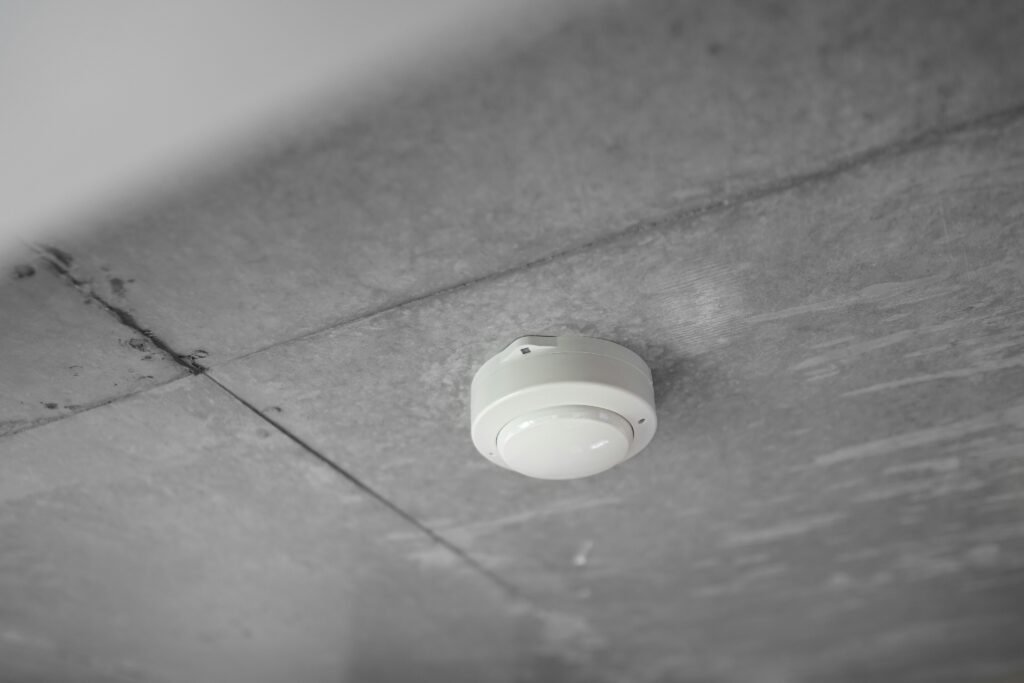
Smoke detector batteries are a home safety essential — when the chirping starts or it’s time for the annual test, you need to know exactly what battery your detector takes, how to replace it, and how long the new battery will last. This guide covers everything: what batteries smoke detectors use (9V, AA, or sealed lithium), step-by-step battery replacement for Kidde, First Alert, and hardwired detectors, how long smoke detector batteries last, 10-year sealed battery options, and carbon monoxide detector battery replacement.
For smoke detector types including Kidde, First Alert, hardwired, photoelectric, dual sensor, and when to replace your detector entirely, see our article on smoke detector types — Kidde, First Alert, hardwired, photoelectric, dual sensor, and replacement guide.
What Battery Does a Smoke Detector Take?
Smoke detectors use one of three battery types depending on the model:
| Battery Type | Common Models | Notes |
| 9-volt (9V) | Most Kidde, First Alert, BRK standard models | Most common; rectangular with snap terminals |
| AA (1.5V x3) | Some First Alert, newer Kidde models | 3 AA batteries; check detector label |
| Sealed lithium (10-year) | Kidde 10-year, First Alert 10-year models | Built-in; replace entire unit when expired |
| CR123A (3V lithium) | Some commercial/specialty detectors | Less common in residential |
9-Volt Smoke Detector Battery — The Most Common Type
The 9-volt battery is the most common smoke detector battery in American homes. It is the rectangular battery with two snap-together terminals on the same end. When buying replacement 9-volt batteries for smoke detectors, choose name-brand batteries — Energizer, Duracell, or Rayovac. Avoid generic or dollar-store 9V batteries for smoke detectors — their capacity and consistency are lower, meaning they may not provide the full year of reliable power that name-brand batteries do. Lithium 9V batteries (such as Energizer Ultimate Lithium 9V) last longer than alkaline 9V — up to 5-10 years in a smoke detector — and perform better in extreme temperatures.
What Batteries Do Smoke Detectors Use — Checking Your Specific Model
To confirm exactly what battery your smoke detector takes: look on the back or side of the detector — battery type is printed on the label alongside the model number. You can also open the battery compartment — the compartment shape and terminal configuration make it immediately clear whether it needs a 9V, AA, or another battery type. If the battery compartment has a snap connector with no visible slots, it takes a 9V. If it has slots or a tray, it takes AA batteries.
How Long Do Smoke Detector Batteries Last?
| Battery Type | Typical Lifespan in Smoke Detector | When to Replace |
| Alkaline 9V | 6-12 months | Annually — replace every 12 months |
| Lithium 9V (e.g., Energizer Ultimate Lithium) | Up to 5 years | When low-battery chirp sounds |
| AA alkaline (x3) | 6-12 months | Annually |
| Sealed 10-year lithium | 10 years | Replace entire detector at 10 years |
The standard recommendation from the NFPA (National Fire Protection Association) and smoke detector manufacturers is to replace standard batteries in smoke detectors at least once per year — even if the low-battery warning has not sounded. The annual battery replacement is easy to remember by linking it to a recurring event, such as daylight saving time changes in spring and fall, or your birthday. Smoke detector batteries can fail earlier than expected in very hot attic locations, very cold garages, or environments with high humidity.
How to Test Smoke Detector Battery
Testing your smoke detector battery is simple and should be done monthly. Press and hold the test button on the face of the detector for 3-5 seconds. A working alarm will sound a loud series of beeps. If the alarm does not sound or sounds weakly: replace the battery immediately. Do not wait for the low-battery chirp to confirm the battery is good — the test button is the definitive check. Most smoke detectors also have a green LED that lights when the unit has power; a red LED that flashes every 30-60 seconds indicates normal operation.
How to Change a Smoke Detector Battery — Step by Step
How to Change Battery in Standard Battery-Powered Smoke Detector
- Locate your smoke detector — it is typically mounted on the ceiling or high on a wall
- Twist or slide the detector body off the mounting bracket — most units twist counterclockwise to remove
- Open the battery compartment — usually a slide or flip cover on the back
- Remove the old battery — for a 9V, unhook the snap connector; for AA batteries, remove from the tray
- Insert the new battery — for 9V, snap the connector firmly onto the battery terminals; for AA, follow the +/- indicators in the tray
- Close the battery compartment
- Reattach the detector to its mounting bracket — align the tabs and twist clockwise
- Press the test button to confirm the alarm sounds — this verifies the new battery is working
How to Change Battery in Hardwired Smoke Detector
Hardwired smoke detectors are connected to your home’s electrical wiring but also have a backup battery. Replacing the backup battery in a hardwired detector follows the same general process, with one important note: the detector is always powered by the wiring — the battery is only a backup for power outages. You do not need to turn off the power to replace the backup battery.
- Remove the detector from the mounting bracket (twist counterclockwise)
- The detector will remain connected to the ceiling via a wiring harness — it stays plugged in
- Open the battery compartment on the back of the detector
- Replace the battery (typically a 9V alkaline) — disconnect the old one, connect the new one
- Close the compartment and reattach to the bracket
- Press the test button — the alarm will sound
Kidde Smoke Detector Without Battery — What Happens?
A Kidde smoke detector without a battery (in a battery-only model) will not function at all — it needs the battery to power the alarm circuit, sensor, and warning chirp. For hardwired Kidde models, the detector will continue to function on wall power without the backup battery, but will not operate during a power outage. The Kidde smoke alarm will typically chirp repeatedly when the battery is missing or dead as a warning signal. Never leave a battery-only smoke detector without a battery installed — replace it immediately or the detector provides no protection.
How to Change Smoke Detector Battery — Brand-Specific Guides
Kidde Smoke Alarm Battery Replacement
Kidde smoke alarms typically use a 9V battery (check the label — some models use 3 AA batteries). To replace the Kidde battery: twist the alarm body counterclockwise off the mounting plate, open the battery drawer on the back or side, disconnect the old 9V battery’s snap connector, snap the new battery onto the connector, close the drawer, reattach to the mounting plate, and press the test button. Kidde recommends using a 9V battery from a major brand. If your Kidde smoke alarm has a hush button, press it after replacing the battery to stop any residual chirping.
First Alert Smoke Detector Battery Replacement
First Alert smoke detectors use either a 9V battery or AA batteries depending on the model — check the back of the unit. First Alert models with a 10-year sealed battery (marked as ’10 Year’ on the label) cannot have their battery replaced — replace the entire unit when it reaches 10 years old. For standard First Alert models: remove the unit from the bracket (twist counterclockwise), locate the battery compartment, replace the battery, reattach, and test. The First Alert SCO5CN combination smoke and CO detector takes a 9V battery; the SA511B takes 3 AA batteries.
Fire Alarm Battery Replacement — Commercial and Home Systems
For home standalone smoke alarms, battery replacement follows the steps above. For whole-home interconnected fire alarm systems (where all alarms sound when one detects smoke), the backup batteries are typically located in a central control panel in the basement or utility room — these use larger sealed lead-acid batteries or multiple AA/9V batteries and may require a professional to service. ADT smoke detector battery replacement for monitored systems: contact ADT directly before replacing batteries, as the low-battery signal may transmit to ADT’s monitoring center and they can guide you through the replacement without triggering a false alarm dispatch.
10-Year Smoke Detector — Sealed Battery Models
Ten-year sealed lithium battery smoke detectors are becoming the standard recommendation from fire safety organizations. These detectors contain a non-removable 10-year lithium battery that powers the alarm for its entire useful life — there is no annual battery replacement required.
| 10-Year Detector | Notes |
| Kidde 10-Year Smoke Alarm (i12060) | Sealed battery; end-of-life warning when approaching 10 years; no battery to change |
| First Alert SA511 10-Year | Sealed lithium; same concept; replace entire unit at 10 years |
| Kidde 10-Year Combo (CO + Smoke) | Sealed battery; combination alarm; replace at 10 years |
At the end of the 10-year lifespan, the detector will emit a different chirping pattern (typically 3 chirps every 30 seconds) to indicate end-of-life — this is different from the low-battery chirp pattern. When you hear this signal, replace the entire detector. NFPA recommends replacing all smoke detectors every 10 years regardless of type — so 10-year sealed battery detectors align their battery life with the recommended replacement cycle.
Carbon Monoxide Detector Battery Replacement
Carbon monoxide detectors use the same battery types as smoke detectors — typically 9V or AA batteries. The replacement process is identical to smoke detector battery replacement. Key differences for CO detector maintenance:
- CO detectors also have a 7-10 year lifespan for the CO sensor itself — even with fresh batteries, an old CO detector may not accurately detect carbon monoxide
- Replace the battery at least once a year (or when the low-battery chirp sounds)
- Test the CO detector monthly using the test button — if it does not sound, replace the battery first, then the unit if needed
- Combination smoke/CO detectors (like First Alert’s SCO5 series and Kidde’s combination models) follow the same battery replacement process as standalone units
- Changing carbon monoxide alarm battery: remove from bracket, open battery compartment, replace 9V or AA batteries, reattach, test
How to Remove Battery from Smoke Detector — Silencing a Chirping Alarm
If your smoke detector is chirping and you want to silence it while you get a replacement battery, you can remove the battery to stop the chirp temporarily. Important: a smoke detector without a battery (battery-only model) provides NO fire protection — never leave it without a battery for more than a few minutes. To remove the battery:
- Twist the detector counterclockwise off its mounting bracket
- Open the battery compartment
- Remove or disconnect the battery
- Install the new battery immediately — do not leave the detector unprotected
If the chirping continues after replacing the battery, the detector itself may have reached end-of-life or have a fault. Press and hold the reset/hush button for 15-20 seconds to clear any residual charge. If chirping persists, replace the detector.
For smoke detector types, the difference between ionization and photoelectric, Kidde and First Alert comparisons, and when to replace your smoke detector, see our article on smoke detector types — Kidde, First Alert, hardwired, photoelectric, and replacement guide.
For official smoke detector safety guidance and battery recommendations, see NFPA — Smoke Alarms in the Home. For Kidde smoke detector manuals and battery guides, see Kidde — smoke and carbon monoxide alarms.
For home safety and lifestyle guides including door repair, home improvement, and DIY tips, see our home improvement and lifestyle section on TheChronex.
Smoke Detector Placement — Where to Put Smoke Detectors
Proper smoke detector placement is as important as the detector itself. The NFPA recommends: at least one smoke alarm on every level of the home including the basement; inside every bedroom; outside every sleeping area (in the hallway outside bedrooms); in the living room, den, or family room. For ceiling installation, place the detector in the center of the ceiling if possible, or at least 4 inches from any wall. For wall installation, place the unit 4 to 12 inches from the ceiling. Avoid placing smoke detectors within 10 feet of cooking appliances to reduce false alarms from cooking smoke; do not place them in garages where car exhaust can cause false alarms; avoid placement near windows, doors, or forced-air vents where drafts can interfere with detection. Interconnected smoke detectors — either hardwired or wirelessly linked — provide the best whole-home coverage because when one alarm sounds, all alarms in the home sound simultaneously, giving everyone maximum warning time regardless of where they are in the house.
Bottom Line
| Most common smoke detector battery | 9-volt (9V) alkaline — snap connector |
| Best 9V battery for smoke detector | Energizer or Duracell alkaline; Energizer Ultimate Lithium for longer life |
| How long do batteries last? | Alkaline 9V: 6-12 months; Lithium 9V: up to 5 years; Sealed 10-year: 10 years |
| How often to replace | At least once per year (alkaline); or when low-battery chirp sounds |
| How to test battery | Press and hold test button 3-5 seconds — alarm should sound loudly |
| Hardwired battery replacement | Same process; unit stays connected to wiring; just replace backup battery |
| Kidde without battery | Battery-only models won’t work; hardwired models still work but no backup |
| 10-year detector | Sealed lithium; replace entire unit at end of life — no battery changes needed |
| CO detector battery | Same types and process as smoke detectors; also replace CO sensor every 7-10 years |
Frequently Asked Questions
What battery does a smoke detector take?
Most smoke detectors take a 9-volt (9V) battery — the rectangular battery with two terminals on the same end. Some newer models, including certain First Alert and Kidde units, use three AA batteries instead. Sealed 10-year battery models have a non-replaceable built-in lithium battery and require no battery replacement for the life of the detector. To confirm which battery your specific detector uses, check the label on the back of the unit or open the battery compartment — the shape makes it immediately obvious. Always use name-brand batteries (Energizer, Duracell) in smoke detectors for maximum reliability.
How do I change a smoke detector battery?
To change a smoke detector battery: twist the detector counterclockwise off the mounting bracket, open the battery compartment on the back, disconnect or remove the old battery (unhook the snap connector for 9V, or pull AA batteries from the tray), insert the new battery making sure terminals are correctly connected, close the compartment, reattach the detector to the bracket by twisting clockwise, then press and hold the test button for 3-5 seconds to confirm the new battery works. The alarm should sound loudly. For hardwired detectors, the same process applies — the unit stays connected to the ceiling wiring while you replace the backup battery.
How long do smoke detector batteries last?
Standard alkaline 9V batteries in smoke detectors typically last 6-12 months. The NFPA recommends replacing smoke detector batteries at least once per year — even if the low-battery warning has not sounded. Lithium 9V batteries (like Energizer Ultimate Lithium) last significantly longer in smoke detectors — up to 5 years. Sealed 10-year lithium battery smoke detectors require no battery replacement for 10 years and then the entire unit must be replaced. Smoke detector batteries can fail earlier in extreme environments such as very hot attics, cold garages, or high-humidity areas.
Why does my smoke detector keep chirping after battery replacement?
If your smoke detector keeps chirping after you replace the battery, try pressing and holding the reset button for 15-20 seconds to clear any residual charge in the capacitor. If the chirping continues after resetting, check that the new battery is correctly inserted and making firm contact with both terminals. If the battery is new and correctly installed and the chirping continues, the smoke detector itself may have reached end-of-life (smoke detectors should be replaced every 10 years) or developed a fault. Replace the detector if it continues chirping after a confirmed good battery and reset.