
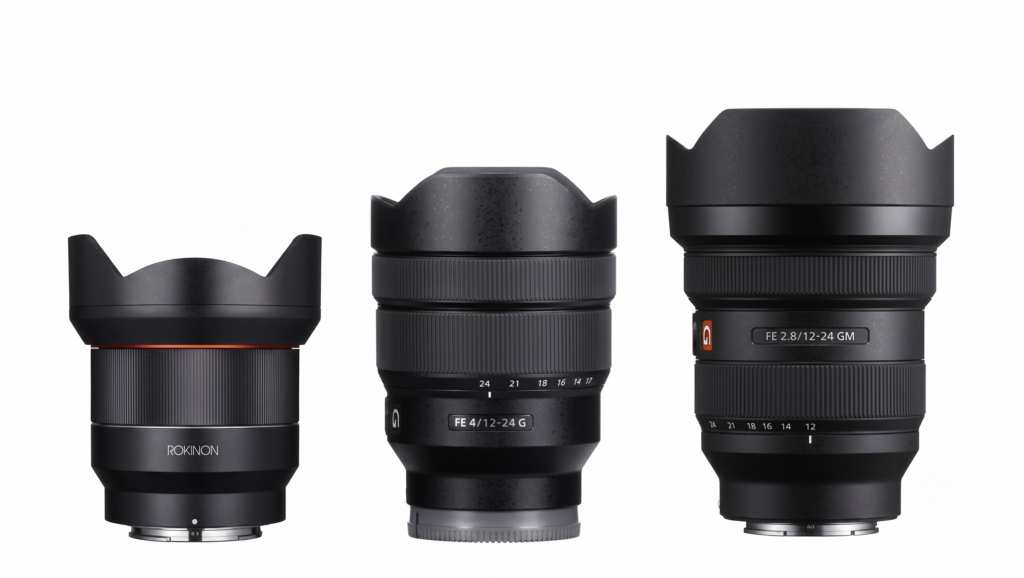
Sony ultra-wide-angle zoom lenses for the FE mount cover a range of options from budget-friendly manual focus options to premium autofocus primes. If you shoot landscapes, astrophotography, or architecture on a Sony full-frame camera, going wider than 20mm opens up creative possibilities that a standard kit lens simply cannot deliver. This guide compares four real-world lens options tested in the field — the Sigma 17mm f4, Laowa 15mm f2 Zero-D, Sony 20-70mm f4 G, and Rokinon 14mm f2.8 — with actual Milky Way test results, sharpness comparisons, and a clear recommendation for each use case.
Wide vs Ultra-Wide: What Do the Focal Lengths Actually Mean?
Before comparing specific lenses, it helps to understand what these focal lengths mean in practical terms. On a full-frame camera, 24mm to 35mm is considered wide angle. Anything shorter than 24mm is ultra-wide. The difference between 20mm and 14mm looks modest on paper but produces a dramatically different field of view in real shooting situations.
The jump from 24mm to 20mm is noticeable. The jump from 20mm to 15mm is even more significant, particularly when the sun or a dramatic sky element falls within the frame. Ultra-wide lenses also produce more pronounced perspective distortion, which works in favor of certain compositions and against others.
For landscape photographers, ultra-wide lenses allow foreground elements to dominate the frame while keeping the background in context. For astrophotography, going wider means more sky in a single frame and shorter exposures needed to avoid star trails.
The Sony Ultra-Wide-Angle Zoom Lenses and Primes Tested
These four lenses were tested in real landscape and astrophotography conditions in Maine, covering both daytime field of view and sharpness tests and nighttime Milky Way shooting. Each lens represents a different position on the cost and capability spectrum.
Sigma 17mm f4 Contemporary (Sony FE)
The Sigma 17mm f4 is the newest and most compact option in this group. It weighs just 250g and looks almost comically small on a Sony full-frame body. Despite its size, it produces outstanding image quality across the entire frame in good light.
In sharpness tests at the center and mid-frame, the Sigma 17mm trails only the Sony 20-70mm and is essentially impossible to distinguish from it without extreme pixel-peeping. Corner sharpness is also very good with Lightroom’s distortion correction applied.
One standout finding: the Sigma appears to have a higher T-stop than its nominal f4 rating suggests. In Milky Way shooting, it required only about one stop of additional exposure to match the Laowa 15mm f2 rather than the expected two stops. This is a meaningful real-world advantage for low-light work.
The Sigma 17mm f4 is an autofocus lens, which gives it a practical advantage for general landscape photography where you may want to focus quickly or use focus tracking.
- Weight: 250g (8.8 oz)
- Price new: $599 (B&H)
- Autofocus: Yes
- Filter thread: 67mm
Venus Laowa 15mm f2 Zero-D (Sony FE)
The Laowa 15mm f2 Zero-D is a manual focus lens that has been available for several years and built a strong reputation in the astrophotography community. Its f2 aperture gives it a two-stop advantage over f4 lenses on paper, and the Zero-D designation means it is designed for minimal distortion despite its ultra-wide focal length.
In Milky Way testing, the Laowa produced the cleanest single images of the group by a clear margin due to its aperture advantage. The galactic center and fine star detail were significantly more visible compared to f4 options shooting at the same ISO and shutter speed.
The trade-off is sharpness wide open. At f2, the Laowa is noticeably softer than the Sigma 17mm f4 in the same conditions. For astrophotography where per-star brightness matters more than resolution, this is acceptable. For daytime landscape work where edge-to-edge sharpness is important, closing down to f5.6 or f8 gives better results.
The Laowa is also significantly heavier than the Sigma at 575g and larger. It requires manual exposure and focus settings which adds steps to the workflow for general shooting but is standard practice for astrophotography regardless.
- Weight: 575g (1 lb 4.3 oz)
- Price new: $649 (B&H) | Used: $350–500 (eBay)
- Autofocus: No (manual focus)
- Filter thread: 72mm
Sony 20-70mm f4 G (FE Mount)
The Sony 20-70mm f4 G is not strictly an ultra-wide lens but is included as the practical baseline. At 20mm it sits at the wide end of ultra-wide territory. At 70mm it covers moderate telephoto. This versatility makes it an excellent single-lens solution for landscape photographers who do not want to carry multiple primes.
In sharpness testing it was the sharpest of the group in center and mid-frame, slightly ahead of the Sigma 17mm. Corner performance was also strong. The zoom range means you can compose without physically moving, and the autofocus is fast and accurate.
For Milky Way photography, 20mm is generally considered the minimum acceptable focal length. It works but requires stacking multiple exposures or relying heavily on AI denoise tools to produce clean results at high ISO and f4.
- Weight: 545g (1 lb 3.2 oz)
- Price new: $1,098 (B&H) | Used: $800–900 (eBay)
- Autofocus: Yes
- Filter thread: 72mm
Rokinon 14mm f2.8 ED AS IF UMC (E-Mount)
The Rokinon 14mm f2.8 is the budget option in this group and the widest focal length tested. At 14mm on a full-frame sensor, the field of view is extremely wide and perspective distortion is significant.
Unfortunately, in practical testing the Rokinon underperformed significantly. In Milky Way shooting, achieving accurate focus manually proved extremely difficult and most shots came out slightly soft. Even when focus was close to correct, overall sharpness was below the Sigma 17mm and Laowa 15mm. The aperture advantage over f4 lenses amounted to only about one-third of a stop in practice, far less than the theoretical 1.5 stop advantage of f2.8 over f4.
For casual shooting in bright conditions where maximum image quality is not critical, the Rokinon can produce acceptable results. For serious landscape or astrophotography work, its limitations are significant enough to recommend spending more on one of the other options.
- Weight: 687g with adapter (1 lb 8.2 oz)
- Price new (E-mount): $299 (B&H) | Used: $150–200 (eBay)
- Autofocus: No (manual focus)
Daytime Image Quality: Sharpness and Distortion
In standard landscape conditions shooting at f16, the center and mid-frame sharpness differences between the lenses are subtle. The Sony 20-70mm leads slightly, followed closely by the Sigma 17mm. Separating these two without extreme pixel analysis is genuinely difficult. Both produce landscapes and architectural shots that are sharp enough for large prints without hesitation.
The Laowa 15mm in daytime shooting is good but slightly softer in direct comparisons, though this may partly reflect the challenges of manual focusing under bright conditions. Its Zero-D design delivers on its distortion promise, producing minimal barrel distortion despite the 15mm focal length. This is a real advantage for architectural and cityscape photographers who dislike spending time on distortion correction in post-processing.
All four lenses show some vignetting at wide apertures that is reduced significantly by closing down. Lightroom’s lens profile corrections handle the distortion and vignetting for the Sony and Sigma automatically. For the Laowa and Rokinon, manual profile selection is required.
Milky Way Photography Results: Can f4 Sony Lenses Compete?
Astrophotography is where the aperture differences between these lenses become most relevant. Conventional advice recommends at least f2.8 for Milky Way photography and considers f4 a significant compromise.
Testing showed that this conventional wisdom needs updating in 2026. Modern AI denoise tools — specifically Adobe Lightroom’s Denoise feature and Topaz Denoise AI — have changed the calculus substantially.
With Lightroom Denoise applied to a single f4 image from the Sigma 17mm, the result was cleaner than the untreated f2 Laowa image. The Sigma’s higher-than-expected T-stop means it captures more light than f4 suggests, and the AI denoise eliminates noise more effectively than the aperture gap would imply.
Image stacking with Sequator using seven Sigma frames produced a cleaner base image, but the subsequent application of Topaz Denoise produced results slightly softer than the single-image Lightroom Denoise approach. The stacking workflow remains valid but is no longer necessary to produce excellent results.
The Laowa 15mm f2 remains the best single-exposure choice when noise reduction is not applied. If you prefer not to rely on AI denoising, or if you need to shoot rapidly without time for processing, the aperture advantage is real and meaningful.
Weight and Portability Comparison
For photographers who hike to shooting locations, weight matters as much as image quality. The Sigma 17mm f4’s 250g is extraordinary for a sharp wide-angle lens. Carrying it alongside other lenses barely registers in a camera bag.
The Sony 20-70mm and Laowa are in a similar weight class around 545–575g. The Rokinon with adapter is the heaviest at 687g. The difference between the Sigma and the others is dramatic and becomes significant on long hikes or when every gram counts.
Price Comparison: New vs Used Market
Budget is often the deciding factor when choosing between these Sony ultra-wide-angle options. Here is how the options stack up:
- Rokinon 14mm f2.8 (E-mount): $299 new, $150–200 used — cheapest option by far
- Sigma 17mm f4: $599 new — no used market yet as it is a recent release
- Laowa 15mm f2: $649 new, $350–500 used — best used value for astrophotography
- Sony 20-70mm f4 G: $1,098 new, $800–900 used — most expensive but most versatile
The Sigma will likely appear on the used market in the coming months as early adopters upgrade or move on, which will make it available at $400–500 used — an excellent value for its performance level.
Which Sony Ultra-Wide-Angle Lens Should You Buy?
Best all-around choice: Sigma 17mm f4
The Sigma 17mm f4 is the standout recommendation for most Sony FE mount photographers. Its sharpness matches the much more expensive Sony G zoom. Its weight is unmatched. Its autofocus works for general shooting. And its higher-than-rated T-stop makes it more capable in low light than the f4 label suggests. When it appears on the used market, it will be one of the best value wide-angle lenses available for Sony E-mount.
Best for astrophotography: Laowa 15mm f2 Zero-D
If your primary use is Milky Way and night sky photography and you prefer maximum aperture without relying on AI denoise, the Laowa 15mm f2 is the right choice. The aperture advantage is real and visible in single-image captures. Its Zero-D design also makes it valuable for architecture. Look for it used at $350–450 for best value.
Best if you want one lens for everything: Sony 20-70mm f4 G
If you want a single lens that covers ultra-wide to short telephoto with excellent autofocus and the sharpest output of the group, the Sony 20-70mm f4 G is the answer. The price is steep but the versatility is real. It is not as wide as the other options, but 20mm covers the vast majority of wide-angle landscape and travel shooting situations.
Avoid for serious photography: Rokinon 14mm f2.8
The Rokinon is only worth considering if you are strictly budget-constrained and understand its limitations going in. The real-world aperture advantage is much smaller than the spec sheet suggests, the manual focus is difficult to use reliably especially at night, and overall sharpness falls behind the Sigma and Laowa. Spend more if you can.
Tips for Shooting with Ultra-Wide Lenses
- Use a strong foreground element. Ultra-wide lenses exaggerate perspective, making foreground objects appear larger relative to the background. A rock, a flower, or a leading line close to the lens adds depth to landscapes.
- Watch the horizon. Slight tilts in the camera are amplified at ultra-wide focal lengths. Use a level or the camera’s electronic level to keep horizons straight.
- Apply lens corrections. Even lenses marketed as low-distortion benefit from profile corrections in Lightroom. Always check the Lens Corrections panel and apply the relevant profile.
- For astrophotography, apply AI denoise before making other adjustments. The noise reduction preserves detail that subsequent sharpening and contrast adjustments can then work with effectively.
- Use the 500 rule or PhotoPills to determine maximum exposure time before star trailing becomes visible at your focal length.
Frequently Asked Questions
What is the best ultra-wide-angle lens for Sony FE mount?
For most photographers, the Sigma 17mm f4 Contemporary is the best all-around ultra-wide-angle lens for Sony FE mount. It combines outstanding sharpness, a remarkably compact and light build, and autofocus capability at a reasonable price. For dedicated astrophotography, the Laowa 15mm f2 Zero-D offers a genuine aperture advantage for cleaner single-exposure night sky images.
Can you shoot the Milky Way with an f4 Sony lens?
Yes, and modern AI denoise tools have made this significantly more practical than it was even two years ago. The Sigma 17mm f4’s actual light transmission is higher than f4 suggests due to its T-stop characteristics, and Lightroom’s AI Denoise can produce a single-image result cleaner than an unprocessed f2 image from the Laowa. If you prefer not to use AI denoise, f2 or f2.8 remains preferable for maximum flexibility.
Is the Laowa 15mm f2 worth buying used?
Yes. At $350–450 on the used market, the Laowa 15mm f2 Zero-D offers excellent value for astrophotographers and landscape photographers who want a faster aperture than f4 zoom options provide. Its manual focus limitation is a non-issue for astrophotography where you focus manually regardless, and the Zero-D distortion control is a genuine advantage for architecture and real estate shooting.
What is the cheapest good wide-angle lens for Sony E-mount?
The cheapest viable option is the Rokinon 14mm f2.8 at $150–200 used. However, its practical limitations in real-world shooting make the Laowa 15mm used at $350–450 a better investment if your budget allows. The Sigma 17mm f4, when it appears on the used market, should offer outstanding value at expected prices of $400–500.
Final Thoughts
Choosing between Sony ultra-wide-angle zoom lenses and primes comes down to three questions: how wide do you actually need to go, how important is autofocus, and what is your primary shooting scenario.
If you already own the Sony 20-70mm f4 G, adding the Sigma 17mm f4 gives you a meaningful step wider with negligible weight penalty. If astrophotography is your main motivation, the Laowa 15mm f2 used is the clearest recommendation. If budget is the limiting factor, wait for the Sigma to appear second-hand rather than compromising with the Rokinon.
The good news is that both the Sigma 17mm and Laowa 15mm are genuinely excellent lenses. Whichever you choose, the image quality will be the least of your concerns on your next landscape or night sky shoot.