
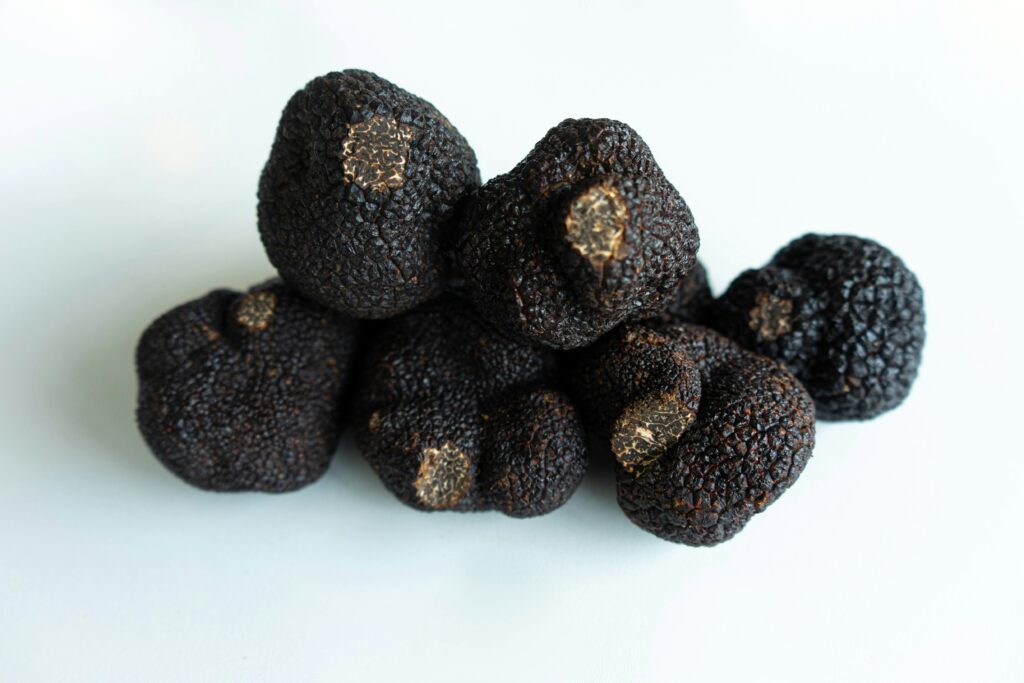
A truffle is one of the most prized — and most expensive — foods in the world. It can cost thousands of dollars per pound, it cannot be reliably farmed, and it grows underground in the roots of specific trees in specific regions. Yet despite its fame, many people are unclear on what a truffle actually is, what it tastes like, or why it commands such extraordinary prices.
This guide covers everything: what truffles are biologically, the main types, how they grow, what they taste like, why they are so expensive, how to cook with them, and how to buy them.
What Is a Truffle?
A truffle is a type of underground fungus — specifically a subterranean fruiting body of mycorrhizal fungi in the genus Tuber. It grows beneath the soil surface in a symbiotic relationship with the roots of specific host trees, most commonly oak, hazelnut, poplar, and beech.
Truffles are closely related to morel mushrooms and other prized culinary fungi, but they grow entirely underground, making them very difficult to find and impossible to grow conventionally. They can only be located by trained animals (typically dogs, traditionally pigs) that detect their powerful aroma.
A critical disambiguation: the word ‘truffle’ refers to two completely different things in food contexts:
- The fungus: The underground, fresh-dug Tuber fungus that is one of the world’s most expensive ingredients
- The chocolate truffle: A round chocolate confection, named only because its round, rough appearance resembles the fungus — it contains no actual truffle
This article covers the fungus.
Is a Truffle a Mushroom?
Yes and no. Truffles are fungi, as mushrooms are — they are both in the kingdom Fungi. However, truffles are not mushrooms in the technical sense because they produce their spores underground in an enclosed fruiting body rather than on above-ground stalks with gills or caps.
Mushrooms grow above ground and spread spores through the air. Truffles grow below ground and spread spores through animals that dig them up and eat them. This underground strategy is why truffles develop their intense, penetrating aroma — to attract animals that will dig them up and spread their spores.
In culinary usage, truffles are grouped with mushrooms because they share similar flavor profiles and culinary applications, but biologically they are distinct.
How Do Truffles Grow?
Truffle growth is one of the most complex and poorly understood processes in mycology. The process involves:
- Spore germination: Truffle spores germinate in soil and must encounter the hair-like root tips (mycorrhizae) of a compatible host tree
- Symbiotic relationship formation: The truffle fungus wraps around and penetrates the host tree roots, forming a mycorrhizal network that exchanges nutrients — the tree provides carbohydrates to the fungus; the fungus helps the tree absorb water and minerals
- Development: Once the symbiosis is established, the actual truffle body begins developing underground — this process takes months to years
- Maturation: Temperature, humidity, soil type, and rainfall all affect whether the truffle reaches maturity; the conditions must be specific
The process is so unpredictable that even in regions with perfect conditions, truffles cannot be reliably cultivated from scratch. ‘Truffle orchards’ exist — plantations of inoculated host trees — but even these produce truffles inconsistently, and wild truffles are generally considered superior in flavor.
Truffles contain over 200 different aromatic molecules and have been described as containing over 9,000 different genes in genomic analysis. Their odor metabolism activates as they mature, broadcasting their presence to animals who dig them up and spread their spores — nature’s distribution system.
Types of Truffles: The Main Varieties
| Truffle Type | Scientific Name | Season | Flavor Profile |
| White Truffle (Alba) | Tuber magnatum | Oct–Dec | Intensely aromatic; garlicky, earthy, honey; used raw |
| Black Périgord Truffle | Tuber melanosporum | Dec–Mar | Deep, earthy, chocolate, musk; survives heat |
| Summer Black Truffle | Tuber aestivum | May–Aug | Milder, nuttier; less intense than Périgord |
| Burgundy Truffle | Tuber uncinatum | Sep–Jan | Moderate intensity; earthy, hazelnut |
| Oregon White Truffle | Tuber oregonense | Dec–Mar | Fruity, garlicky; grown in Pacific Northwest |
| Chinese Truffle | Tuber indicum | Oct–Feb | Minimal aroma; often used to adulterate Italian truffles |
White Truffles (Tuber magnatum) — The Most Valuable
The white truffle of Alba, Piedmont (Italy) is the most prized and most expensive truffle in the world. White truffles are not actually white — they range from pale cream to yellow-ochre on the outside, with a marbled cream interior. They are found primarily in Piedmont and Tuscany in Italy, with smaller quantities in Croatia, Hungary, and a few other regions.
White truffles are never cooked. Heat destroys their volatile aromatic compounds, which is where all of the flavor resides. They are shaved raw — using a dedicated truffle shaver/slicer — over warm dishes just before serving: typically pasta, risotto, or eggs. The aroma fills the room when a fresh white truffle is shaved.
Price: Fresh white truffles routinely sell for $2,000 to $5,000 per pound at retail, with premium examples at auction sometimes reaching $100,000 per kilogram for extraordinary specimens.
Black Périgord Truffles (Tuber melanosporum) — The Black Diamond
The black truffle of Périgord (France) and Norcia (Italy) is the most important truffle for cooking with heat. Unlike white truffles, black Périgord truffles retain and develop their flavor when gently warmed — making them suitable for incorporated cooking (sauces, stuffed dishes, pastry-wrapped preparations).
Black truffles have a rounded, warty black exterior and a dark gray-brown interior with white veining. The flavor is deeply earthy, slightly chocolatey, and musky — less aromatic than white truffles but more versatile in cooking applications.
Price: $800 to $2,000 per pound for fresh, high-quality black truffles. Significantly less expensive than white truffles but still among the most expensive foods by weight.
Summer Truffles (Tuber aestivum) — The Accessible Option
Summer truffles are the most widely available and least expensive of the culinary truffle species. Their flavor is noticeably milder than Périgord or Alba truffles — earthy and nutty rather than intensely aromatic. They are what most people encounter in lower-price truffle products (truffle oils, truffle salts, truffle pasta).
Price: $100 to $400 per pound. The accessibility makes them the entry point for most consumers encountering fresh truffles.
What Do Truffles Taste Like?
Truffle flavor is notoriously difficult to describe — the most common descriptors used by chefs and writers include:
- Earthy — deep, rich soil character
- Garlicky — particularly prominent in white truffles
- Musky — an animalistic, almost fermented quality
- Honey-like sweetness — particularly in white truffles
- Chocolate and coffee notes — particularly in black Périgord truffles
- Nutty — more prominent in summer truffles
The flavor is primarily delivered through aroma rather than taste. A significant portion of the truffle experience occurs through retronasal olfaction — the aromas travel from the mouth up through the back of the nasal passage while eating. This is why truffles shaved over a warm dish fill the room with aroma and why heat is so important — warming the truffle (or the dish underneath it) releases volatile aromatic compounds.
Importantly: fresh truffles and truffle products taste dramatically different. Most ‘truffle’ products — truffle oil, truffle chips, truffle butter in most restaurants — use synthetic 2,4-dithiapentane (a laboratory-produced aroma compound) rather than actual truffle. Synthetic truffle oil tastes aggressively chemical and one-dimensional compared to fresh truffle. People who love ‘truffle flavor’ from mass-market products and then taste real truffles for the first time often notice they are quite different.
Why Are Truffles So Expensive?
Truffle prices are among the highest of any food on earth. The reasons are structural:
- Cannot be reliably farmed: Despite decades of attempts, truffles cannot be grown predictably. Even inoculated truffle orchards produce erratically — some years abundantly, some years nothing. Wild truffles must be found, not grown.
- Require trained animals to find: Truffle hunting requires trained dogs (or traditionally, female pigs) who detect the aroma underground. Training a truffle dog takes years; maintaining a working truffle hunter and dog is expensive.
- Short season and short shelf life: Fresh white truffles are available only from October through December. Once harvested, they begin losing aroma immediately — a fresh white truffle at peak is extraordinary; the same truffle 10 days later is a shadow of itself.
- Specific geography: High-quality truffles grow in very limited geographic regions where soil chemistry, climate, altitude, and host tree populations align. The Italian Piedmont and French Périgord cannot be replicated elsewhere.
- Climate sensitivity: Truffle harvests fluctuate significantly with annual rainfall and temperature patterns. A dry summer in Piedmont directly reduces white truffle availability the following autumn.
- Intense demand from fine dining: Global fine dining’s appetite for truffles creates premium pricing that any supply shortage immediately amplifies
Truffle Products: What to Know Before Buying
The truffle product market has significant quality variation:
Truffle Oil
Most commercially available truffle oil — including the vast majority of ‘white truffle oil’ and ‘black truffle oil’ sold in grocery stores and used in restaurants — does not contain real truffle. It contains olive oil flavored with 2,4-dithiapentane, the synthetic compound that mimics one component of truffle aroma. Real truffle-infused oil (infused with actual truffle pieces) is available but far more expensive and degrades quickly.
If a bottle of ‘truffle oil’ costs less than $15 and doesn’t list actual truffle in the ingredients, it almost certainly contains synthetic flavoring only.
Truffle Salt, Truffle Butter, Truffle Honey
Products made with actual summer truffle pieces (Tuber aestivum or Tuber uncinatum) can be genuinely good — these are the most accessible ways to incorporate real truffle flavor into cooking at a reasonable price. Read ingredient labels: look for actual truffle pieces (not ‘natural truffle flavor’ or ‘truffle aroma’), and note the percentage.
Canned/Jarred Truffles
Preserved truffles (in brine or oil) retain some flavor but lose most of the volatile aromatics of fresh truffles. They work better than nothing in cooked applications but are not a substitute for fresh in dishes where truffle aroma is the point.
How to Cook With Truffles
The key principles for cooking with fresh truffles:
- White truffles: Never cook. Shave raw over warm dishes immediately before serving — eggs, pasta, risotto, polenta. The dish’s warmth releases the aroma; heat above approximately 70°C destroys it.
- Black Périgord truffles: Can be incorporated into cooking with gentle heat — sauces, under skin of poultry before roasting, in pastry crusts (beef Wellington). Also excellent raw-shaved over warm dishes.
- Less is sometimes more: Truffle paired with delicate, neutral bases (eggs, pasta, rice, butter, cream) allows the aroma to be the star. Too many competing flavors mute the truffle.
- Infusing: Fresh truffles stored overnight with eggs in a sealed container infuse the eggs through the shells with truffle aroma — a simple and effective technique.
- Truffle shaver/mandoline: A dedicated truffle slicer creates the thin, even shavings that maximize surface area and aroma release. An adjustable mandoline works as a substitute.
Classic Dishes That Feature Truffles
- Tagliatelle al tartufo: Fresh egg pasta with white truffle shaved tableside
- Risotto al tartufo: Creamy risotto finished with black truffle or garnished with white
- Truffle scrambled eggs: Eggs that have been stored with a truffle for 24 hours, cooked gently
- Beef Wellington: Classic preparation sometimes includes black truffle in the duxelles layer
- Truffle potato gratin: Thin-sliced potatoes with black truffle and cream
- Périgueux sauce: Classic French truffle sauce — demi-glace finished with black truffle
Where to Buy Fresh Truffles in the US
- Specialty food retailers: Eataly, Dean & DeLuca, and similar retailers stock fresh truffles in season
- Online suppliers: Marx Foods, Earthy.com, and La Boite NY ship fresh truffles during season
- Oregon truffles: The Oregon white truffle and Oregon black truffle (Pacific Northwest) are harvested December through March and are significantly less expensive than European varieties while still offering genuine truffle aroma. Available through Oregon Truffle Festival vendors.
- Truffle markets: During peak white truffle season (October–December), truffle markets in Italy (Alba’s market is the most famous) offer the freshest and best-priced product in the world
Frequently Asked Questions
What is a truffle?
A truffle is a subterranean fungus that grows in a symbiotic relationship with the roots of specific trees (oak, hazelnut, beech). It is prized in cooking for its intensely aromatic flavor and is one of the world’s most expensive foods. The two main culinary varieties are the white truffle (Tuber magnatum) from Piedmont, Italy, and the black Périgord truffle (Tuber melanosporum) from France and Italy.
What does truffle taste like?
Truffle has a complex flavor described as earthy, garlicky, musky, and honey-like with nutty and forest floor notes. The flavor is delivered primarily through aroma — much of the experience is olfactory rather than taste. White truffles are more intensely aromatic and garlicky; black Périgord truffles are earthier and slightly chocolatey. Most truffle products (truffle oil, truffle chips) use synthetic flavoring that is aggressively one-dimensional compared to fresh truffle.
Why are truffles so expensive?
Truffles cannot be reliably farmed — they grow wild in very specific geographic areas and require trained dogs to locate underground. Their season is short (white truffles are available only October through December), they deteriorate rapidly after harvest, and they grow only in limited regions where soil and climate conditions are exactly right. These supply constraints, combined with intense demand from fine dining globally, produce the extraordinary pricing.
Is truffle a mushroom?
Truffles are fungi, like mushrooms, but technically they are not mushrooms — they grow and produce spores underground rather than above ground. In culinary contexts, they are grouped with mushrooms and prepared in similar ways, but biologically they are a distinct type of fungi in the genus Tuber.
Are chocolate truffles real truffles?
No. Chocolate truffles are a confection named after the truffle fungus because their rounded, rough shape resembles the underground fungus. They contain no actual truffle. The naming is purely visual analogy.
Final Thoughts
Truffles occupy a unique place in the culinary world — no other ingredient combines so much legend, complexity, and price in something that grows spontaneously in the ground. The white truffle of Alba is arguably the single most intensely aromatic food ingredient in existence. Understanding what truffles actually are makes it much easier to evaluate when truffle products are worth the premium, how to cook with fresh truffles when you have access to them, and why the experience of fresh truffle is so categorically different from the synthetic version most people encounter in everyday truffle-flavored products.